
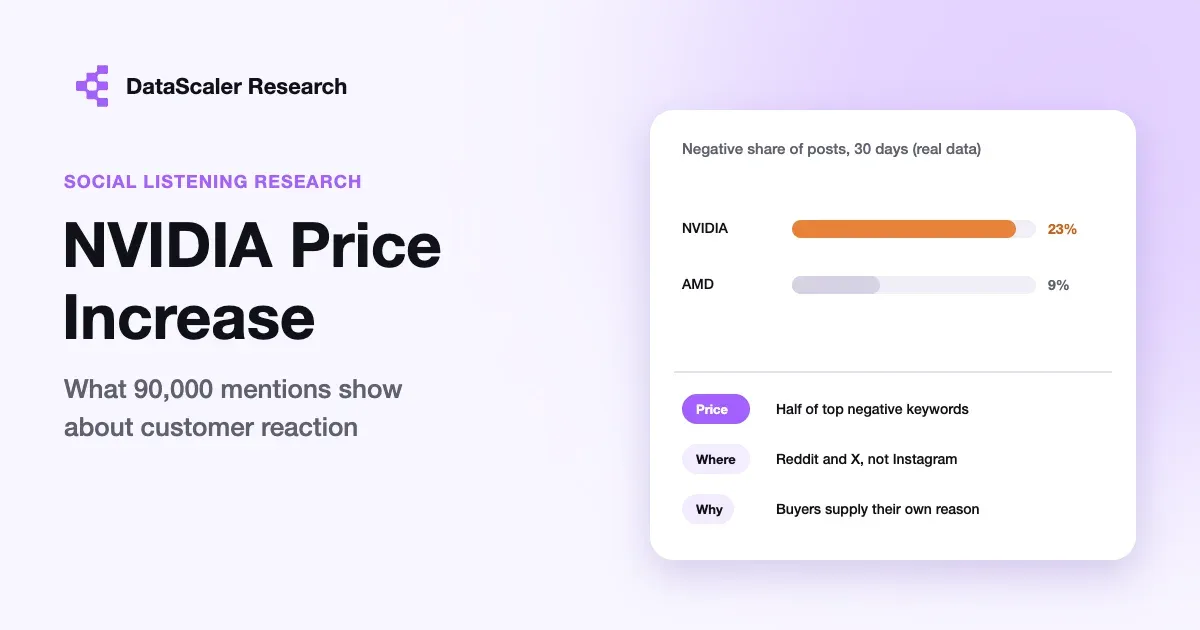
Quick answer: Customers rarely react to a price increase with one complaint. They react in clusters: "price", "MSRP", "overpriced" and "value for money" rise together, the criticism concentrates on discussion platforms such as Reddit and X, and buyers attach their own explanation for why the price went up. In DataScaler's 30-day data on NVIDIA, collected while RTX 50 graphics card prices were climbing, 23% of posts were negative, against 9% for AMD on almost the same volume of mentions. Price terms made up half of NVIDIA's top negative keywords.
This article walks through what the data shows and how any brand can monitor its own price increase the same way.
The context: a price increase everyone is talking about
In November 2026, prices for NVIDIA's RTX 50 graphics cards rose again. Tech outlets linked the increase to rising memory costs and to demand from AI data centers, and reported street prices for the RTX 5090 far above its launch price. One YouTube short in our sample, noting that the RTX 5090 had more than doubled from its $1,999 MSRP, reached about 45 million views.
That makes NVIDIA a useful case. Most brands raising prices in 2026, because of tariffs, materials or shipping, face the same question on a smaller scale: what will customers say, and where?
What 90,000 mentions show
We compared NVIDIA with its closest competitor, AMD, over the same 30-day window. The two brands had almost identical conversation volume, which makes the sentiment gap easy to read.
Metric | NVIDIA | AMD |
|---|---|---|
Posts | 5,918 | 5,342 |
Mentions (posts and comments) | 90,344 | 90,187 |
Positive posts | 32% | 43% |
Negative posts | 23% | 9% |
Price-related negative keyword hits | 2,504 | 1,389 |
AMD's brand covers CPUs as well as graphics cards, so the comparison is not product for product. It still shows how differently two brands in the same category are discussed during the same price cycle.
Finding 1: Price becomes the main complaint
Price-related terms made up 50% of the hits among NVIDIA's top 30 negative keywords, against 38% for AMD. The terms also became more specific:
Negative keyword | NVIDIA | AMD |
|---|---|---|
price | 624 | 512 |
gpu pricing | 484 | 90 |
price increase | 132 | 58 |
rtx 5090 price | 98 | not in top 30 |
msrp | 82 | not in top 30 |
overpriced | 73 | not in top 30 |
Generic words like "price" appear for every brand. The warning sign is the arrival of specific ones: a named model's price, "MSRP" and "overpriced". They show that people are comparing what they pay now with what they expected to pay.
Finding 2: The same topic can carry the opposite verdict
Price is not only a complaint. It also shows up in positive posts, and the ratio is what matters:
- NVIDIA: "price" appeared 249 times in positive contexts and 624 times in negative ones, about 2.5 negative for every positive.
- AMD: "price" appeared 476 times positive and 512 times negative, close to even. "Price value" was positive 610 times for AMD, against 248 negative.

The topic was the same for both brands. The verdict was not. A competitor that is perceived as better value can gain from your price increase without changing anything.
Finding 3: Backlash concentrates on discussion platforms
Negative share of posts by platform, NVIDIA compared with AMD:

Instagram stayed calm for both brands. Reddit, X, YouTube and TikTok carried the criticism, and NVIDIA's gap over AMD was widest on X and YouTube. If you only watch the channels where your brand posts, a price backlash can look much smaller than it is. Our guide to Reddit social listening covers how to follow those threads.
Finding 4: Customers write their own explanation
Next to price, NVIDIA's negative keywords included "ai focus" (89), "fake frames" (92) and "ai features" (66). Many gamers connected higher prices to a belief that NVIDIA now cares more about AI customers than about them.
That is the most useful signal for any brand. When a price goes up, people look for a reason. If the brand does not give one, customers supply their own, and it is rarely flattering. Tracking which explanation spreads tells you what your price communication needs to answer.
Trustpilot was negative for both brands (83% for NVIDIA, 75% for AMD), but those reviews are mostly about orders, support and returns. Keep them separate from the price conversation, or you will misread both.
How to monitor your own price increase
- Set a baseline before the change. Record sentiment, negative share and top negative keywords for 30 days before the new price goes live.
- Track a price keyword cluster, not one word. Include "price", "price increase", "expensive", "overpriced", "worth it", "MSRP" or "list price", and your product names with "price".
- Split by platform. Watch Reddit, X, YouTube comments and TikTok separately from your own channels.
- Read the explanations. Tag what people say caused the increase, such as costs, tariffs, greed or a change in focus, and answer the most common one in your FAQ, product pages and support replies.
- Watch one or two competitors. If their value perception improves while yours drops, your price increase is shifting demand, not just mood.
- Separate service complaints. Keep review-site complaints about delivery and support out of the price analysis.
For a deeper method on reading sentiment, see our guide to brand sentiment analysis. To share the results with your team, use the structure in a social listening report people will use.
Planning a price change? Run a free brand report to see your current sentiment, negative keywords and platforms before you announce it, or book a demo.
FAQ
How do customers react to a price increase?
They react in clusters of related complaints, such as price, value for money and "overpriced", mostly on discussion platforms like Reddit and X. In our NVIDIA data, price terms made up half of the top negative keywords during a period of rising prices.
How long should you monitor sentiment after a price increase?
Track at least 30 days before and 30 to 60 days after the change, so you can separate the first reaction from a lasting shift in value perception.
Which platforms show price backlash first?
Discussion platforms. In our data, Reddit and X had the highest negative share for NVIDIA, while Instagram stayed below 5% negative for both NVIDIA and AMD.
Can a competitor benefit from your price increase?
Yes. In the same window, AMD's mentions of price were close to evenly split between positive and negative, while NVIDIA's were about 2.5 to 1 negative. Value perception moved towards the competitor without it doing anything.
What should a brand say when it raises prices?
Give a clear reason before customers invent one, explain what the customer still gets for the price, and answer the most common objection directly in your FAQ and support replies.
Methodology and sources
NVIDIA and AMD figures come from DataScaler brand reports on public posts and comments collected between October 12 and November 11, 2026, across YouTube, TikTok, X, Reddit, Instagram, Facebook, Pinterest and Trustpilot. Some posts were published before that window. Sentiment is model-classified at post level; keyword counts are totals across platforms. AMD's tracked brand includes CPUs and graphics cards. This is an analysis of public data only. Price increase context is from HotHardware, TechRadar and Windows Report.
Want to know how customers will react to your next price change? Generate a free brand report, or book a demo.