
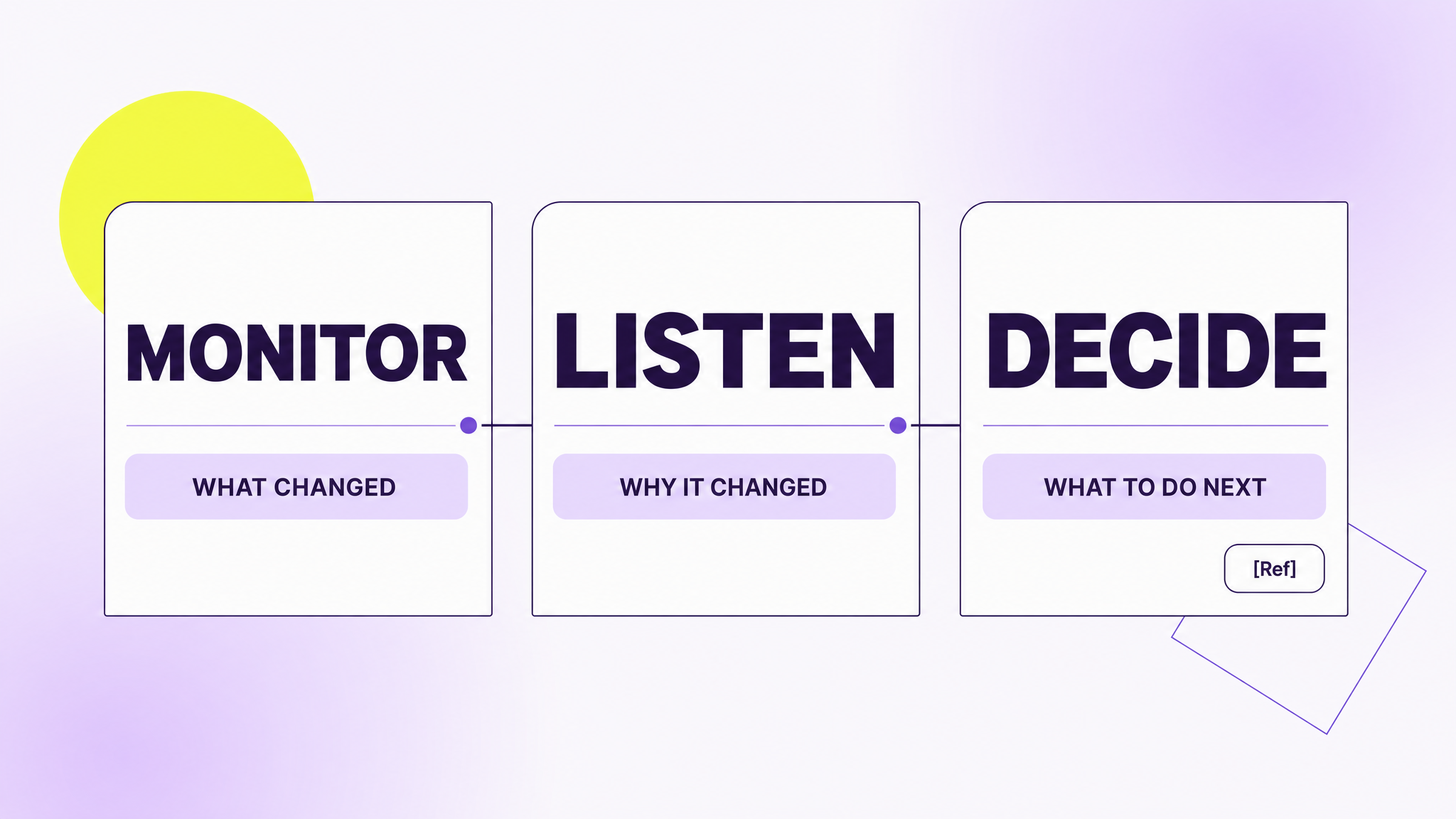
Social monitoring, social listening, and brand intelligence handle different questions in the same workflow. Monitoring detects a change. Listening explains the pattern. Brand intelligence evaluates the business impact and assigns the next step.
Suppose a monitoring alert shows an increase in negative mentions. Listening may find that the discussion concerns compatibility and is concentrated in YouTube comments and Reddit. Brand intelligence then checks the evidence, estimates the impact, and decides whether product, support, or marketing owns the response.
Brand intelligence is the practice of combining market, competitor, customer, and public-conversation evidence so a team can decide what to do, who owns the action, and when to review the result. Social monitoring and social listening supply inputs; brand intelligence connects those inputs to a business decision.
The three levels
Level | Primary question | Typical output | Best used for |
|---|---|---|---|
Social monitoring | What happened? | Mentions, distribution changes, engagement, and alerts | Daily mentions, campaigns, direct response, and fast-moving events |
Social listening | Why are people saying this? | Themes, sentiment, platform differences, and customer language | Cross-source issues, launch feedback, platform splits, and language change |
Brand intelligence | What does it mean, and who acts? | Source-linked judgment, priority, owner, and review date | Cross-functional or high-impact decisions that need reviewable evidence |
Monitoring is fast, but volume does not establish a cause. Listening groups posts, comments, and reviews to see whether a theme repeats across sources or comes from one high-reach item. Brand intelligence connects that evidence to awareness, positioning, conversion, product experience, support, and reputation risk.
The levels complement one another. Reliable alerts provide an entry point. Source-linked listening supplies context. Brand intelligence turns the evidence into a decision.
How a 30-day Anker sample moves from monitoring to action
The Anker public social-discussion sample comes from a 30-day DataScaler report published on May 22, 2026. It includes the public posts, visible comments, and reviews shown in the report, not CRM, support tickets, sales data, or first-party customer records.
The figures demonstrate the analysis levels. They do not represent every Anker customer or establish an industry benchmark.
Monitoring establishes scale
The sample recorded 41.4K brand mentions, 56.6M total reach, 215K comments, 167K shares, 45% share of voice, and a 38.23% engagement rate. Those numbers establish visibility and activity, but not where interest formed or why buyers hesitated.
Listening adds context
Positive sentiment was approximately 55% on TikTok and 53% on Instagram. Negative sentiment was approximately 30% on YouTube and 28% on Reddit. Fast charging, power banks, design, portability, and reliability recurred in positive discussion. Compatibility, overheating, durability, charging speed, and price appeared as common friction.
Discovery-oriented platforms carried more positive attention; evaluation-oriented sources exposed more purchase concerns. Platform roles and customer language make the scale metrics interpretable.

Brand intelligence assigns the work
Product and support teams can inspect the source posts about compatibility, overheating, durability, and charging performance. Marketing can check whether current product information addresses questions on evaluation platforms. Platform teams can treat discovery and evaluation channels differently.
Before changing messaging or escalating an issue, the team should confirm how many independent sources support the pattern, whether it persists, and whether one high-reach item distorted the result.
A daily operating workflow
- Detect a change. Review volume, sentiment, high-engagement content, review trends, and competitor moves. Treat the alert as an investigation entry point.
- Separate signal types. Keep demand, trust, conversion friction, product experience, and competitor change distinct.
- Inspect the sources. Open the posts, comments, and reviews behind the theme and check frequency, distribution, and reach effects.
- Evaluate business impact. Identify possible effects on awareness, positioning, conversion, retention, product experience, or reputation.
- Record the action and review date. Assign a reply, FAQ, creator brief, messaging change, product investigation, or continued monitoring.

When to increase the analysis depth
Monitoring is often enough for daily mentions, campaign comments, and questions with a standard response. Use social listening when an issue appears across sources, launch feedback conflicts, platform sentiment diverges, or customer language changes.
Move into brand intelligence when the result may affect product, positioning, support, launch planning, or revenue, or when several teams need to use the same evidence. The higher the cost of a wrong judgment, the more important source links, boundaries, owners, and review mechanisms become.
Three common mistakes
Mistake | Consequence | Correction |
|---|---|---|
Using mention volume to explain cause | One high-reach item may drive the result | Check themes, platforms, and independent sources |
Replacing evidence with an automated summary | Teams cannot review the classification | Keep post, comment, and review references |
Recommending action without an owner | Insight remains in the report | Record the task, team, and review date |
Where DataScaler fits
DataScaler organizes public social and review signals into a concise brief, separates recurring patterns, and attaches source references. Marketing, product, support, and leadership can open the same posts and comments before deciding what to do. It supports the public-conversation part of the workflow and does not replace CRM, support, sales, or first-party research.
DataScaler's brand monitoring workflow detects changes in mentions, sentiment, risks, and competitors. Its social listening workflow adds customer language, platform context, and source evidence before a team moves the signal into brand intelligence.
FAQ
What is brand intelligence used for?
Brand intelligence is used to prioritize brand, product, marketing, support, and reputation decisions with evidence that teams can review. Typical outputs include the issue, supporting sources, likely business impact, owner, next action, and review date.
How is brand intelligence different from social listening?
Social listening explains patterns in public discussion. Brand intelligence connects those patterns to source evidence, competitor context, business impact, priority, ownership, and action.
Does brand intelligence include competitive intelligence?
They overlap. Brand intelligence focuses on how the market understands your brand; competitive intelligence adds competitor actions, positioning, and benchmarks. Share of voice, platform roles, and trust risks often use both.
Will AI replace social monitoring?
No. Brands still need dependable alerts, campaign tracking, direct engagement, and event detection. AI can classify and summarize; people still verify sources, judge importance, and assign responsibility.