
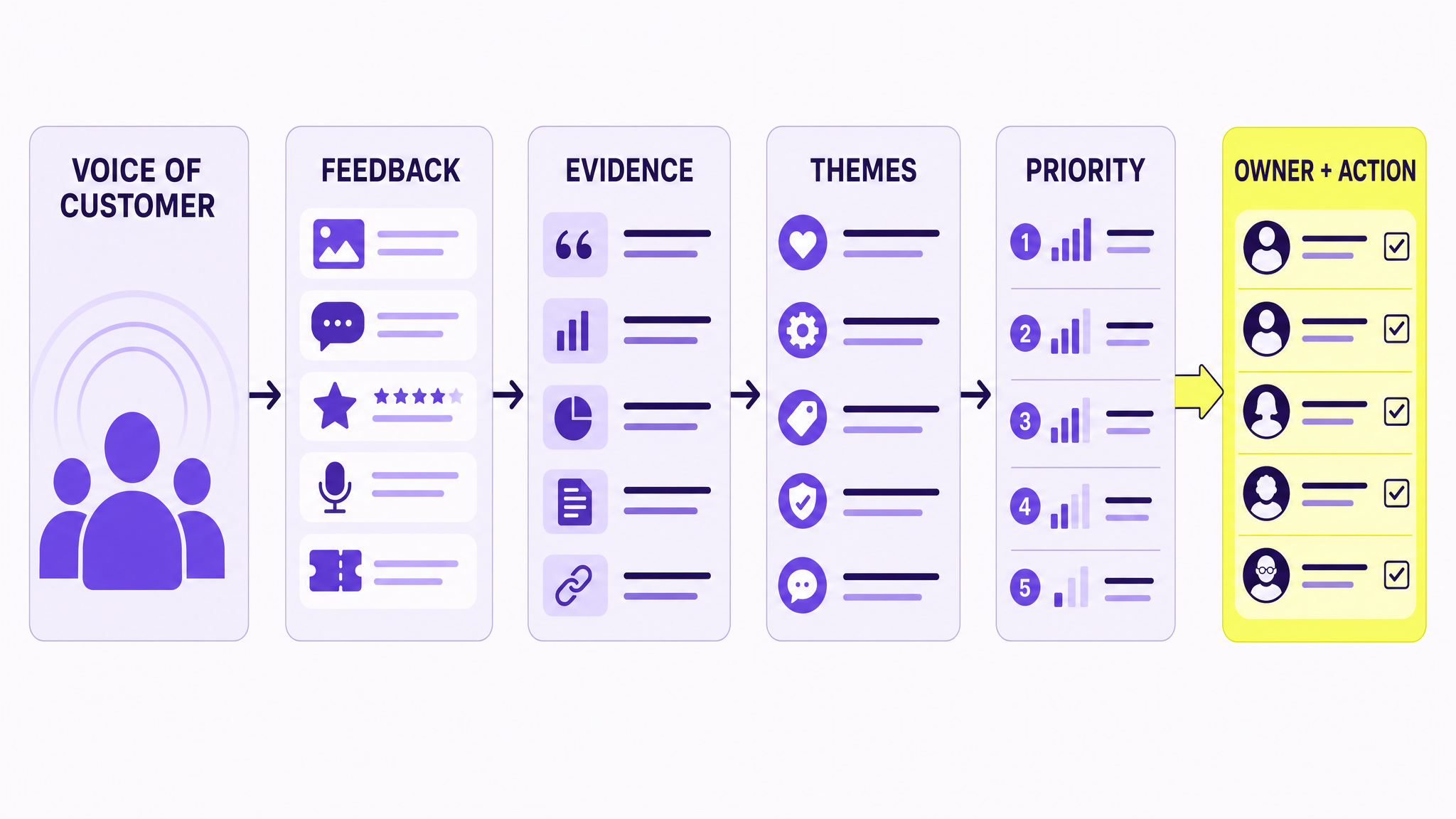
Voice of Customer analysis turns customer language into decisions a team can verify and own. The work covers more than collecting feedback. It organizes recurring needs and friction, checks the source evidence, estimates business impact, and assigns a next step.
Quick answer
Voice of Customer analysis is the process of collecting customer feedback, grouping it into recurring themes, validating those themes against source material, and deciding which issues or opportunities deserve action.
A useful VOC analysis preserves the path from a conclusion back to the posts, comments, reviews, interviews, surveys, or support records that produced it. That path lets product, marketing, support, and leadership inspect the same evidence.
Voice of Customer analysis in five steps
- Define the question and boundary: Name the decision, time window, and included and excluded sources.
- Organize the feedback: Keep customer language while grouping demand, trust, experience, conversion, and ownership signals.
- Verify the sources: Check how many independent sources support a theme, where it appears, and whether one high-reach item dominates it.
- Set priority: Weigh business impact together with evidence strength instead of relying on volume or sentiment alone.
- Assign the work: Give each priority an owner, a next action, and a review date.
What is Voice of Customer analysis?
New to the idea itself? Start with what voice of the customer means, with six real examples. This article focuses on how to analyze VOC data once you have it.
Voice of Customer analysis, often shortened to VOC analysis, examines what customers say about a product, brand, or experience. It looks for repeated language, unmet needs, reasons for confidence, points of friction, and changes over time.
The raw material can come from several places:
- public posts, comments, forums, and reviews
- surveys and customer interviews
- support tickets and chat transcripts
- sales calls, win-loss notes, and CRM records
- product feedback forms and community discussions
The sources available to a team determine the scope of the conclusion. Public social conversation can reveal how buyers describe a category and where trust is forming or weakening. Private support and CRM data answer different questions about known customers. A report should state which sources were included before presenting its findings.
This article uses public posts, visible comments, and reviews from published DataScaler examples. It does not include private CRM, support-ticket, sales, or first-party customer data.
VOC analysis vs customer feedback, social listening, and sentiment analysis
These practices often share data, but their outputs serve different jobs.
Practice | Main question | Typical output |
|---|---|---|
Customer feedback collection | What did customers tell us? | Survey responses, reviews, tickets, interview notes |
Sentiment analysis | Is the tone positive, neutral, or negative? | Sentiment labels and aggregate ratios |
Social listening | What patterns are appearing in public conversation? | Themes, platform differences, recurring language |
Voice of Customer analysis | Which customer needs or problems matter, what evidence supports them, and who should act? | Source-linked priorities, owners, and review dates |
Collection provides the material. Sentiment adds a broad description of tone. Social listening explains patterns in public conversation. VOC analysis connects those patterns to a business question and an owner.
For a fuller comparison of the monitoring and decision layers, see Brand Intelligence vs Social Listening vs Social Monitoring.
Voice of Customer analysis methods
Most teams need more than one analysis method. The right combination depends on whether the question is about recurring needs, a specific journey stage, differences between customer groups, or change over time.
Method | Best used for | Evidence to retain |
|---|---|---|
Thematic analysis | Finding repeated needs, benefits, objections, and problems | Customer language, source links, classification notes |
Frequency and source-distribution analysis | Checking whether a theme is broad or concentrated in one source | Theme count, independent sources, platform and time window |
Journey-stage analysis | Locating friction in discovery, evaluation, purchase, setup, or ownership | Stage label, affected product, source context |
Segment or platform comparison | Comparing markets, products, customer groups, or channel roles | Consistent scope, sample size, segment definitions |
Trend analysis | Seeing whether a theme is growing, stable, or declining | Fixed taxonomy, comparable periods, important concurrent events |
These methods answer different questions. A theme can be frequent but concentrated in one thread; a low-volume issue can still matter when it affects safety, conversion, or a high-value segment. Keep the method and evidence boundary beside the conclusion.
How to analyze Voice of Customer data in five steps
1. Define the question and source boundary
Start with a decision the team needs to make. Examples include understanding launch objections, improving product claims, reducing purchase hesitation, or finding repeated support friction.
Record the analysis window, included sources, excluded sources, markets, platforms, and products. This prevents a public-conversation sample from being presented as a complete view of the customer base.
2. Classify feedback by signal type
Broad positive and negative labels hide useful detail. Separate feedback into signal types that map to actual work. A consumer product analysis might use:
- demand and product appeal
- trust and proof
- product experience
- conversion friction
- service and ownership
- competitor or category comparisons
Keep customer language close to the classification. Terms such as “overheating,” “works with my device,” or “worth the price” are easier to verify and route than a generic label such as “product concern.”
3. Verify the pattern at the source
Open the posts, comments, reviews, or records behind each theme. Check how many independent sources contribute to it, whether it appears across platforms, and whether one high-reach item is dominating the result.
Frequency is one signal. Source distribution and context matter as well. Ten similar comments under one viral post carry different evidence from the same concern appearing in reviews, Reddit threads, and YouTube comments over several weeks.
4. Prioritize by business impact and confidence
Two questions help set priority:
- How strongly could this theme affect awareness, conversion, retention, product experience, support load, or reputation?
- How confident is the team that the evidence represents a recurring pattern?
A high-impact theme with evidence from several sources can move into action. A high-impact theme supported by one isolated post may need monitoring or a targeted check first. Lower-impact issues can still matter when they are frequent and inexpensive to fix.
5. Assign an owner, action, and review date
Every priority should end with an operating decision. The action might be a product investigation, clearer compatibility guidance, a new FAQ, a creator brief, a support response, or continued monitoring.
Record the owner, the source links, the decision, and the next review date. This creates a usable feedback loop: the team can later see whether the action reduced the signal, changed customer language, or exposed a different problem.
An Anker example: from public conversation to VOC priorities
DataScaler's published 30-day Anker public social conversation snapshot shows how this method works with a limited public dataset.
Source, calculation basis, and boundary
- Source: DataScaler's Anker public social conversation snapshot, published May 22, 2026
- Window: the 30-day period used in the published report
- Included: public social posts, visible comments and reviews represented in the report
- Excluded: private CRM, support tickets, sales data, and owned customer records
- Use: a worked analysis example, not a complete audit of Anker customers or the consumer-electronics category
This article did not recollect or recalculate Anker's underlying data. The figures below reproduce the definitions used in the published snapshot, and the platform sentiment values remain rounded as reported. Mentions, reach, comments, and shares describe the scale of visible public conversation. Recurring themes and platform differences identify questions for review. Differences in platform visibility, collection scope, and audience mean the results should not be read as population estimates for all Anker customers, an independent audit, or an industry benchmark.
The monitoring layer recorded 41.4K brand mentions, 56.6M total reach, 215K comments, 167K shares, 45% share of voice, and a 38.23% engagement rate. Those figures establish scale.
VOC analysis starts by separating the language inside that activity. Positive discussion repeatedly mentioned fast charging, power banks, design, portability, and reliability. Recurring friction included compatibility, overheating, durability, charging speed, and price.
Platform context sharpened the read. Positive sentiment was approximately 55% on TikTok and 53% on Instagram. Negative sentiment was approximately 30% on YouTube and 28% on Reddit. Discovery-heavy platforms carried more positive attention, while evaluation-heavy sources surfaced more objections.
The practical output is a set of reviewable priorities. Compatibility and charging-performance evidence can go to product and support. Marketing can inspect whether product claims answer the objections visible on evaluation platforms. Each priority should retain the source posts that justify it.

A reusable VOC analysis template
Use one row for each theme. Keep the source references attached rather than storing them in a separate research folder.
Field | What to record |
|---|---|
Business question | The decision this analysis should support |
Theme | The recurring need, benefit, objection, or problem |
Customer language | Exact phrases or close paraphrases from the source material |
Source evidence | Links or record IDs, platform, date, and sample count |
Distribution | Where the theme appears and whether it spans independent sources |
Business impact | Awareness, conversion, retention, product, support, or reputation |
Confidence | High, medium, or low, with a reason |
Owner and action | Team, next step, and due date |
Review date | When the team will check the signal again |

Common VOC analysis mistakes
Treating every mention as equally important
A widely shared complaint, a repeated low-volume problem, and a routine customer question require different responses. Reach, recurrence, context, and business impact should be read together.
Using sentiment as the final answer
An overall positive score can coexist with concentrated purchase friction. A team still needs to know which product promise is being questioned and where the evidence appears.
Removing the source trail
Themes become difficult to challenge or update when the report contains only summaries. Source references let another team inspect the evidence and catch classification errors.
Mixing incompatible data scopes
Public conversation, survey responses, support tickets, and sales notes can complement one another. They should keep their source labels so the team understands what each dataset represents.
Ending with an insight and no owner
An observation has limited value when nobody decides what happens next. A small action with a review date is more useful than a polished conclusion left in a slide deck.
How DataScaler supports source-linked VOC analysis
DataScaler covers the public-conversation portion of a VOC workflow. It does not replace surveys, support, CRM, or sales research. Based on the workflow shown on the current product site, a team can move through five connected views:
- Read the one-page brief: See what changed in volume, sentiment, competitors, and demand.
- Open the `[Ref]` evidence: Follow each finding back to the original posts, comments, and metrics.
- Review the evidence card: Read source, sentiment, and engagement together before accepting a theme.
- Ask a follow-up question: Use the AI Assistant to investigate causes and impact from the evidence on screen.
- Move the finding to the Action Board: Rank the next step by urgency and potential impact, then attach an owner and review window.
The point is not to let AI replace judgment. It is to shorten the distance between noticing a signal, checking the evidence, and deciding what happens next.
When the finding is ready for the team, the DataScaler Lark integration can send the weekly report or anomaly alert into a team chat. The first follow-up questions and source links stay with it instead of being separated into screenshots.

The customer intelligence platform guide explains where public VOC fits beside CRM, CDP, and owned feedback. The social listening metrics guide shows how to measure visibility, interpretation, and action without collapsing them into one score. The consumer-brand social listening guide connects those signals to purchase confidence. See the current workflow on the DataScaler product site; data collection and AI-accuracy questions are covered in the DataScaler product FAQ.
FAQ
What does Voice of Customer analysis include?
VOC analysis can include surveys, interviews, reviews, support records, sales notes, social posts, comments, forums, and product feedback. The report should name the sources it actually used.
What are the main Voice of Customer analysis methods?
Common methods include thematic analysis, frequency and source-distribution analysis, journey-stage analysis, segment comparison, and trend analysis. Teams often combine them: thematic analysis identifies the issue, while source distribution and segment comparison test how broadly the evidence applies.
How is VOC analysis different from sentiment analysis?
Sentiment analysis labels tone. VOC analysis identifies recurring needs and friction, verifies them against source evidence, estimates business impact, and assigns follow-up work.
How often should a team run VOC analysis?
The cadence depends on the decision. Launches and fast-moving incidents may need weekly review. Established products may use a monthly or quarterly cycle. Keeping the source set and classification rules consistent makes changes easier to interpret.
How many comments are needed for a reliable VOC theme?
There is no universal threshold. Review frequency, source diversity, context, reach, and business impact together. A safety issue may deserve review with limited volume, while a general preference may require a broader pattern.
Can public social data replace surveys or support data?
No. Public conversation is useful for market language, discovery, evaluation, and visible friction. Surveys, support, CRM, and sales data cover known customers and private interactions. The sources can be combined when their boundaries remain clear.
What does DataScaler add to a VOC workflow?
DataScaler helps teams find recurring patterns in public social and review data, separate signal types, and follow conclusions back to the source posts and comments. This makes the public-conversation part of VOC analysis easier to verify and route.
Build the next VOC review from source evidence
Enter your brand to generate a free DataScaler report. Review recurring customer themes, inspect the public sources behind them, and decide which signals deserve action.