
Quick answer: Voice of the customer (VoC), also written voice of customer, is the practice of collecting what customers say about your product, in their own words, and turning it into decisions. VoC data comes from surveys and support tickets, but also from reviews, social posts, Reddit threads and return reasons. A working VoC program groups that feedback into themes, checks each theme against the original comments, and gives each one an owner.
The idea has roots in product development research. Abbie Griffin and John Hauser's 1993 paper "The Voice of the Customer" in *Marketing Science* set out how to identify, structure and prioritize customer needs, and asked a question that still trips teams up: is the need customers mention most often also the one that matters most? For a consumer brand today, the raw material has changed. Most of the voice of the customer is already public, in reviews, videos and forums you do not control. This guide explains what VoC covers, shows six real examples from DataScaler's research on consumer brands, and sets out a simple way to start.
What voice of the customer means
Voice of the customer is not a single survey or a score. It is a habit of listening to customers in their own language, at a level of detail where a team can act.
What makes it different from "customer feedback" in general is mostly discipline. VoC keeps the customer's words: "the size runs small in the shoulders" is VoC, while "fit: 3.2 out of 5" is only a metric about it. It sorts hundreds of comments into a short list of themes such as fit, price, reliability, setup or delivery. And it ends with someone responsible for each theme. Without that last step you have a report, not a VoC program.
Where VoC data comes from
Most teams start with the feedback they ask for. Ecommerce brands get more from the feedback they do not ask for, because it arrives before and after the purchase, not only when a survey goes out.
Source | Type | What it tells you best | Weak spot |
|---|---|---|---|
Post-purchase surveys and NPS | Solicited | Satisfaction trends among existing buyers | Only people who bought and chose to answer |
Support tickets and live chat | Solicited | Setup problems, defects, policy confusion | Skews toward problems |
Customer interviews | Solicited | Deep context on why people buy | Small samples, slow |
Marketplace reviews (Amazon and others) | Unsolicited | Product defects and expectation gaps per SKU | Rating inflation; little pre-purchase context |
Social posts and video comments | Unsolicited | First impressions, comparisons, objections before purchase | Noisy; needs filtering |
Reddit and forums | Unsolicited | Detailed "should I buy" and troubleshooting threads | Smaller, more expert audience |
Return reasons | Behavioral | Where expectations and reality diverge | Often a single dropdown choice |
A useful rule of thumb: solicited feedback tells you how buyers feel after the purchase. Unsolicited feedback tells you what stopped other people from buying at all.
Six voice of customer examples from consumer brands
These examples come from DataScaler research published on our blog in 2026. Each shows a different kind of VoC signal and what a team could do with it. Counts are mentions in public conversation, not sales or return rates.
Brand or category | What customers said | What it means | Possible action |
|---|---|---|---|
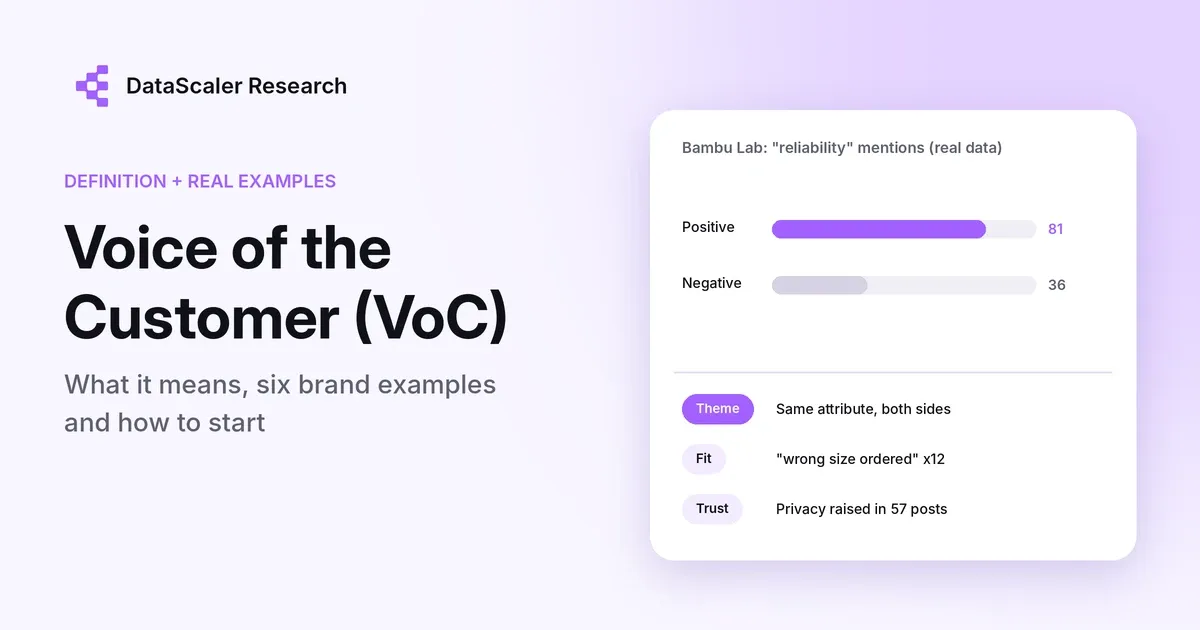
Bambu Lab (3D printers) | "Reliability" appeared in 81 positive and 36 negative mentions | The same attribute is a strength and a complaint at once | Split reliability by model and issue before acting |
Anker (chargers) | Charging speed: 36 positive, 8 negative mentions over a year | Charging speed is the attribute buyers judge first | Lead product pages with tested charging scenarios |
Ugreen (chargers) | "Fast charging" 57 positive; "charging speed" 10 negative | Buyers check how power is shared, not only total wattage | Show per-port power splits on listings |
Ergonomic office chairs (category) | "Lumbar support" was the top demand term (146) and also appeared in 47 negative contexts, next to "back pain" (45) | The main promise is also the main risk | Add fit and adjustment guidance; collect long-term reviews |
Aelfric Eden (apparel) | "Baggy sweatpants" 202 mentions; "wrong size ordered" 12 | Style drives attention; fit friction sits close to checkout | Check fit mentions against size selection and returns |
Furniture seating (category) | Of roughly 200 mentions in 30 days, a small cluster described late deliveries, missing parts and slow support | Few complaints, but each can block setup and lead to a return | Tag by delivery, parts and support; compare with tickets and refunds |

Look at the chart and one thing is hard to miss: the attributes customers praise most are the same ones they complain about. Reliability for Bambu Lab, charging speed for Anker, lumbar support for ergonomic chairs. A VoC program that only counts complaints would flag these as problems. In fact they are the attributes buyers care about most, and the negative mentions show where the promise breaks.
The other lesson sits in the smallest numbers. Twelve "wrong size ordered" mentions, or a handful of missing-parts complaints, will never top a dashboard. But each one is close to a return or a refund. Griffin and Hauser's old question applies: how often something is mentioned is not the same as how much it matters. Rank VoC themes by how close they sit to purchase, return or churn, not by volume.
For the full reports behind these figures, see the Bambu Lab case study, the Anker Reddit analysis, Anker vs Ugreen, the ergonomic chair review analysis, the apparel fit analysis and the furniture complaints analysis.
The voice of the customer process: five steps to start a VoC program
You do not need a research team. A small brand can run a first VoC cycle in two weeks.
- Pick one decision. For example: why did a product's rating drop, or why do visitors leave the product page? A VoC program without a question collects everything and changes nothing.
- Pull two kinds of sources. One you ask for (tickets or a survey) and one you do not (reviews, social comments or Reddit). Using both shows the gap between what buyers tell you and what they tell each other.
- Group comments into themes, then read the originals. Automated tagging is fine for a first pass. Before you act, read 10 to 20 source comments for each theme to check the label means what you think.
- Rank themes by closeness to money. Purchase objections, return reasons and churn signals first; general praise and minor annoyances later.
- Give each theme an owner and a check date. Product, listing copy, support script or pricing. Re-run the same sources four to six weeks later to see whether the theme shrank.
Our voice of customer analysis method goes deeper on step 3, including how to code comments and avoid common tagging mistakes. To catch new themes between cycles, a light weekly brand monitoring routine helps.
A VoC theme log you can copy
Keep one row per theme. If a column stays empty for long, the program has stalled.
Theme | Example in the customer's words | Sources | Closeness to money | Owner | Action | Check date |
|---|---|---|---|---|---|---|
Fit runs small | "Ordered my usual size, had to send it back" | Reviews, returns | High: returns | Product + listing | Update size guide and model measurements | +6 weeks |
Setup confusion | "Took an hour to find the right app setting" | Tickets, Reddit | Medium: support cost | Support | New setup video, pinned FAQ | +4 weeks |
VoC metrics worth tracking
Scores like NPS and CSAT are useful but slow, and they rarely tell you what to change. These are closer to action:
Metric | What it shows |
|---|---|
Share of mentions by theme | Which issues dominate the conversation this month |
Negative share within a theme | Whether a theme is mainly praise or mainly complaint |
New themes this period | Problems that did not exist last month |
Themes linked to returns or tickets | Which VoC signals cost money |
Time from theme to action | Whether the program changes anything |
Common VoC mistakes
The most common one is treating VoC as a survey project. Surveys only reach people who bought, while public conversation often explains the people who did not. Close behind is trusting the label without reading the comments: a "price" theme can mean "too expensive" or "great value", and only the source tells you which.
Two more show up once a program is running. Teams report volume instead of decisions, so a monthly deck of charts replaces owned actions. And they ignore competitors' customers, whose reviews show exactly which objections you could win on.
See your customers' own words in one report. DataScaler reads reviews, Reddit, TikTok, YouTube and other public sources, groups them into themes and links every theme to the original posts. Run a free brand report or book a demo.
FAQ
What is voice of the customer in simple terms?
It is what customers say about your product in their own words, collected from surveys, support, reviews and social media, and organized so your team can act on it.
What is an example of voice of the customer?
An apparel brand sees 12 public mentions of "wrong size ordered" in a month. Few in number, but each points to a likely return, so the team checks them against size selection and return reasons and adjusts the size guide.
What are the main VoC methods?
Surveys, customer interviews, support ticket analysis, review analysis and social listening. Most brands combine one method they control, such as surveys, with one they do not, such as reviews or social posts.
What is the difference between VoC and social listening?
Social listening is one source of VoC. VoC covers all customer feedback, including surveys and support tickets. Social listening covers public online conversation, including people who never bought from you. Our guide to what social listening is covers it in detail.
How do you start a VoC program with a small team?
Pick one business question, combine one solicited and one unsolicited source, group comments into themes, rank them by how close they are to purchase or return, and assign an owner to each. Repeat the cycle every four to six weeks.
What is the difference between voice of the customer and voice of the consumer?
They usually mean the same thing. Voice of the customer is the more common term in business and B2B. Voice of the consumer is used more often by consumer brands and market researchers, and it includes people who have not bought yet, such as shoppers comparing products on Reddit or YouTube. Either way, the work is the same: collect what people say in their own words and turn it into decisions.
Methodology and sources
The six examples summarize DataScaler research articles published in 2026, each based on public posts and comments over the window stated in that article: 90 days (Bambu Lab), one year (Anker), one month (Ugreen) and 30 days (ergonomic chairs, Aelfric Eden and furniture seating). Counts are mentions classified by model, not unique people, sales or return rates. Links to each original report appear in the examples section.
Background: Griffin, A. and Hauser, J. R. (1993), "The Voice of the Customer," *Marketing Science* 12(1): 1–27. Abstract.
Want to hear what your customers are saying where you are not asking? Generate a free brand report, or book a demo to see it on your own products.