
Quick answer: Brand monitoring means tracking where your brand is mentioned online, from social posts and video comments to reviews, forums and news, so you can spot problems and opportunities early. For an ecommerce brand, the useful version watches the places buyers decide, reads comments as well as posts, and turns what it finds into a short weekly list of actions.
Most brand monitoring guides stop at "set up alerts and track sentiment." That is where the trouble starts. Averages hide the conversations that actually move sales, and alerts without rules turn into noise nobody reads. This guide covers what to track, how to read it, when to act, and how to compare brand monitoring tools. It uses 120 days of real public data on Bambu Lab, the 3D printer brand, to show where an average score can mislead.
What is brand monitoring?
Brand monitoring, sometimes called online brand monitoring, is the ongoing tracking of public mentions of your brand, products and key people across social media, video, reviews, forums and news. It answers one question: what are people saying about us, where, and does any of it need a response?
For ecommerce brands it pays off in three places. It catches product and service problems before they reach your ratings. It surfaces the objections buyers raise while comparing you with competitors. And it finds creator and customer content worth reusing.
Three related practices often get mixed up with it:
- Social listening goes further. It looks for patterns across a whole market, including competitors and topics where your brand is never named. Our guide to brand intelligence vs social listening covers the differences. See what social listening is for examples.
- Reputation management is what you do with the findings: responding, fixing, escalating.
- Competitor monitoring applies the same routine to rivals. It deserves its own process; see our weekly competitor monitoring system.
For a small ecommerce team, brand monitoring is the base layer. Get it working before you add the rest.
Where to monitor: sources that matter for ecommerce
Not every mention counts the same. A tweet from a stranger and a 20-minute YouTube review that ranks for "best budget 3D printer" are both "one mention," but only one of them is still shaping purchases six months later.
Source | What it tells an ecommerce brand | How often to check |
|---|---|---|
YouTube reviews and comments | How buyers compare you during research; long-lived and searchable | Weekly, plus alerts on new high-view videos |
TikTok and Instagram | First impressions, unboxing, visual problems | Weekly |
X | Fast-moving complaints, outages, launch reactions | Daily during launches, otherwise weekly |
Reddit and forums | Detailed, honest troubleshooting and "should I buy" threads | Weekly |
Amazon and other marketplace reviews | Product defects and expectation gaps tied to a listing | Weekly per top SKU |
Trustpilot and review sites | Service, delivery and refund problems | Weekly |
News and blogs | Coverage that shapes credibility and links | As it happens |
Two rules follow from this. First, weight sources by influence, not by count. Second, read the comments. A video's title and description tell you what the creator thinks. The comments tell you what buyers think.
If Reddit matters in your category, our Anker Reddit analysis shows what a year of threads looks like.
A real example: what 120 days of Bambu Lab monitoring shows
We ran DataScaler's monitoring on Bambu Lab's public mentions across YouTube, X and Instagram for the 120 days to October 28, 2026. At the post level, the picture looks calm.
Metric (Bambu Lab, 120 days) | Value |
|---|---|
Posts tracked | 375 |
Total mentions (posts + comments) | 1,090 |
Reach | 16.2M, 82% of it from YouTube |
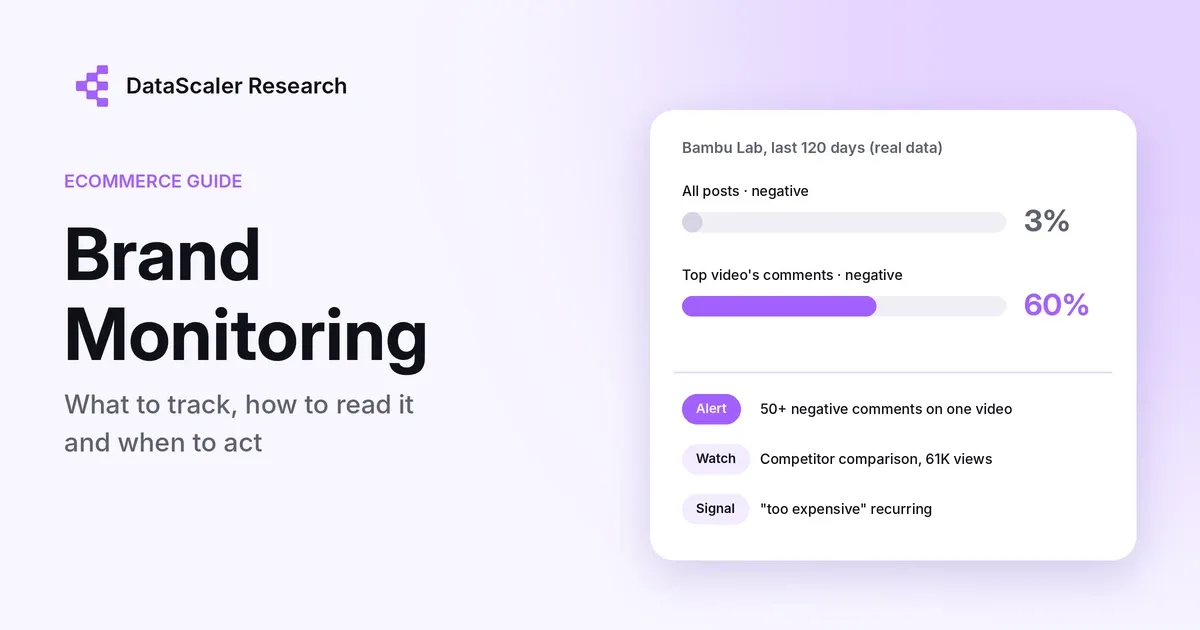
Post sentiment | 65% positive, 33% neutral, 3% negative |
Most frequent positive terms | "easy to use," "multi-color printing," "fast printing," "clean prints" |
Most frequent risk terms | "expensive," "too expensive," "connection issue," "anti-consumer" |
Three percent negative would let most teams move on. The comments tell a different story. Here are four YouTube videos in the dataset, with the sentiment of the comments we captured under each:
Video (YouTube) | Views | Comments analyzed | Negative comments | Positive comments |
|---|---|---|---|---|
"The Satisfying Downfall of Bambu Lab" | 494K | 146 of ~2,000 | 60% | 13% |
"The Kobra X Is 9 HOURS Faster?! I Was Wrong About the Bambu A1" | 61K | 98 | 31% | 22% |
"Bambu Lab 3D Printer Buyer's Guide" | 91K | 163 | 23% | 44% |
"The BIG Multi-Color 3D Printer I Didn't See Coming" (Bambu Lab A2L) | 132K | 69 | 12% | 74% |
Three things stand out.
1. The biggest risk sits in one video, not in the average. The most-viewed video in the set carries 60% negative comments. Its debate is about the company's approach, with words like "closed garden" and "anti-consumer." That is a trust issue, not a product defect, and it will not show up in a review score. One of 375 posts can still be the one a hesitant buyer finds first.
2. Competitor comparisons create objections you need to answer. The Kobra X video claims a competitor finished the same multicolor print "9 hours faster" and costs about $100 less than the A1 Combo. Even if a brand disputes the test, that claim is now part of the buying conversation, and 31% of the comments we captured are negative. Brand monitoring should flag every high-view comparison, because each one is a sales objection with a timestamp.
3. Positive content carries useful signals too. In the buyer's guide, the creator suggests that a lower price would make one model's place in the lineup clearer. Combined with "expensive" and "too expensive" as top risk terms, that is a pricing signal worth passing to the team that sets prices.
A note on the data: comment capture is partial. On the most-viewed video we analyzed 146 of about 2,000 comments, and Instagram does not report reach in this dataset. Good monitoring states these limits instead of hiding them. For a full read of this brand, see the Bambu Lab sample report, and for why a sentiment score can mislead, see our guide to brand sentiment analysis.
How to monitor your brand: a weekly routine
You do not need a war room. A small team can run this in about an hour a week.
- Pull the week's mentions across your sources, including comments on high-view posts.
- Sort by influence, not by date. Views, engagement and search visibility first.
- Read the top items and their comments. Tag each one: product issue, service issue, price, comparison, trust, or praise you can reuse.
- Check against your alert rules (below) and assign an owner to anything that crosses one.
- Write five lines for the team: what changed, the one risk, the one opportunity, what you are doing, and what you will check next week.
The five-line summary matters more than the dashboard. If nobody reads the monitoring, it does not exist. Our guide on building a social listening report people will use covers the format.
When to act: alert rules that cut the noise
Alerts are only useful if they are rare. These starting thresholds are suggestions; tune them to your category's volume.
Signal | Suggested trigger | Usual owner |
|---|---|---|
Negative spike | Negative mentions double week on week | Brand or social lead |
One high-risk item | A single post or video with 50+ negative comments | Brand lead, plus product or support |
New risk term | A term not seen before appears 3+ times in a week | Product or support |
Competitor comparison | A comparison featuring you passes 50K views | Marketing and sales |
Defect cluster | The same defect in 3+ reviews on one SKU | Product and operations |
Positive proof | A creator or buyer praise post outperforms your own content | Marketing, to reuse with permission |
The rules share one idea: they trigger on something a person can act on, not on a score crossing a line.
How to choose brand monitoring software
Brand monitoring tools range from free alerts to enterprise suites. For an ecommerce team, these questions matter more than the feature list:
Question | Why it matters |
|---|---|
Does it cover the sources where your buyers decide? | Many tools are strong on news and X but thin on YouTube comments, Reddit or marketplace reviews. |
Does it read comments, not just posts? | As the Bambu Lab example shows, the risk often sits in the comments. |
Can you click from every number to the posts behind it? | A finding you cannot trace is hard to act on or defend. |
How are limits priced? | Keyword caps, mention caps and seats can make costs hard to predict. |
Does it fit your rhythm? | Real-time alerts suit PR crises; weekly reports suit product and growth decisions. |
Brand monitoring tools compared
Prices are taken from each vendor's pricing page in October 2026.
Tool | Starting price | Best for | Watch out for |
|---|---|---|---|
Free | News and blog mentions | No social comments or reviews | |
$29/mo, billed annually | Tight budgets, high mention volume | 3 topics on the entry plan; light analysis | |
$199/mo, billed annually | Always-on mention alerts | 3 keywords and 2,000 mentions on the entry plan, updated every 12 hours | |
Free plan; Pro $199/mo | Weekly reports that link every finding to the source posts, across 10 platforms including YouTube, TikTok, Reddit and Amazon Reviews | Report-based, not a real-time feed | |
$499/mo, billed annually | Brands whose products show up in photos | Image analysis is not part of the Starter plan | |
Brandwatch | Custom quote | Large insights teams | Annual contracts and enterprise pricing |
For a wider comparison, see our review of Brandwatch alternatives and our list of free social listening tools.
See what your brand monitoring would surface. Run a free brand report on your own brand, or book a demo to set up weekly monitoring for your team.
FAQ
What is brand monitoring?
It is the ongoing tracking of public mentions of your brand across social media, video comments, reviews, forums and news. The goal is to catch problems and opportunities early enough to act on them.
What is the difference between brand monitoring and social listening?
Brand monitoring tracks mentions of your own brand and asks whether any need a response. Social listening analyzes wider conversations, including competitors and category topics where your brand is never named, to find patterns and insights.
What are the best brand monitoring tools?
It depends on budget and sources. Google Alerts is free for news. Awario and Brand24 suit always-on mention tracking on a budget. DataScaler suits ecommerce teams that need YouTube comments, Reddit and Amazon Reviews read together in a weekly report. Brandwatch and YouScan suit larger teams with enterprise budgets.
How do I monitor brand mentions for free?
Start with Google Alerts for news and blogs, set saved searches on X and Reddit, and check YouTube comments on the top videos for your brand name. Free setups miss most comments and reviews, so they suit low-volume brands best.
How often should an ecommerce brand check its mentions?
Weekly for most teams, with alerts for spikes and high-view videos in between. During launches, sales events or a known issue, check daily.
What should a brand monitoring report include?
What changed this week, the biggest risk, the biggest opportunity, the action and owner for each, and links to the posts behind every point. Keep it short enough to read in two minutes.
Methodology and sources
Bambu Lab data comes from DataScaler's monitoring of public YouTube, X and Instagram posts and comments for the 120 days to October 28, 2026. Sentiment is classified by model and comment capture is partial for high-volume videos, as noted in the text. Tool prices are taken from each vendor's public pricing page in October 2026 and may change.
Want to know what people are saying about your brand this week? Generate a free brand report, or book a demo to see it on your own data.