
Quick answer: Social listening, also called social media listening, is the practice of analyzing public online conversation about a brand, its competitors and its category to understand why people feel the way they do, and then acting on it. Social monitoring counts and alerts on mentions. Social listening looks for patterns across them: which platforms drive the conversation, which product attributes people praise or doubt, and what stops them from buying.
Most definitions stop there, which is why social listening can sound abstract. The six examples below come from DataScaler research on consumer brands in 2026. Each one shows a specific thing social listening found that a sentiment score or a mention count would have missed.
How social media listening works
Social media listening has three parts:
- Collecting public posts, comments, videos, reviews and forum threads that mention a brand, product, competitor or topic.
- Analyzing them for themes, sentiment, platforms and change over time.
- Acting on what you find: fixing a product issue, changing a listing, answering an objection in content, or briefing sales.
The third part is what makes it listening rather than collecting. A dashboard nobody acts on is just a record.
Social listening vs social monitoring
The two terms are often used interchangeably, but they answer different questions.
Social monitoring | Social listening | |
|---|---|---|
Main question | What was said about us, and does it need a reply? | Why are people saying it, and what should we change? |
Scope | Your brand mentions | Your brand, competitors and category topics |
Time frame | Real time and daily | Weekly, monthly and over campaigns |
Typical output | Alerts and replies | Themes, insights and decisions |
Owner | Social or support team | Marketing, product, insights |
In practice you need both. Our guide to brand monitoring covers the monitoring side, and brand intelligence vs social listening covers where the lines fall.
What brands use social listening for
Use | Question it answers |
|---|---|
Product feedback | Which attributes do buyers praise or doubt, in their own words? |
Competitor research | What do buyers compare before choosing us or a rival? |
Purchase objections | What stops interested people from buying? |
Campaign and launch tracking | Did the launch change what people say, not just how much? |
Risk detection | Is a complaint spreading, and on which platform? |
Content ideas | Which questions keep coming up that our content does not answer? |
Social listening is also one of the main inputs to a voice of the customer program, alongside surveys and support tickets.
6 social listening examples from consumer brands
1. Bambu Lab: one platform carried almost the whole conversation
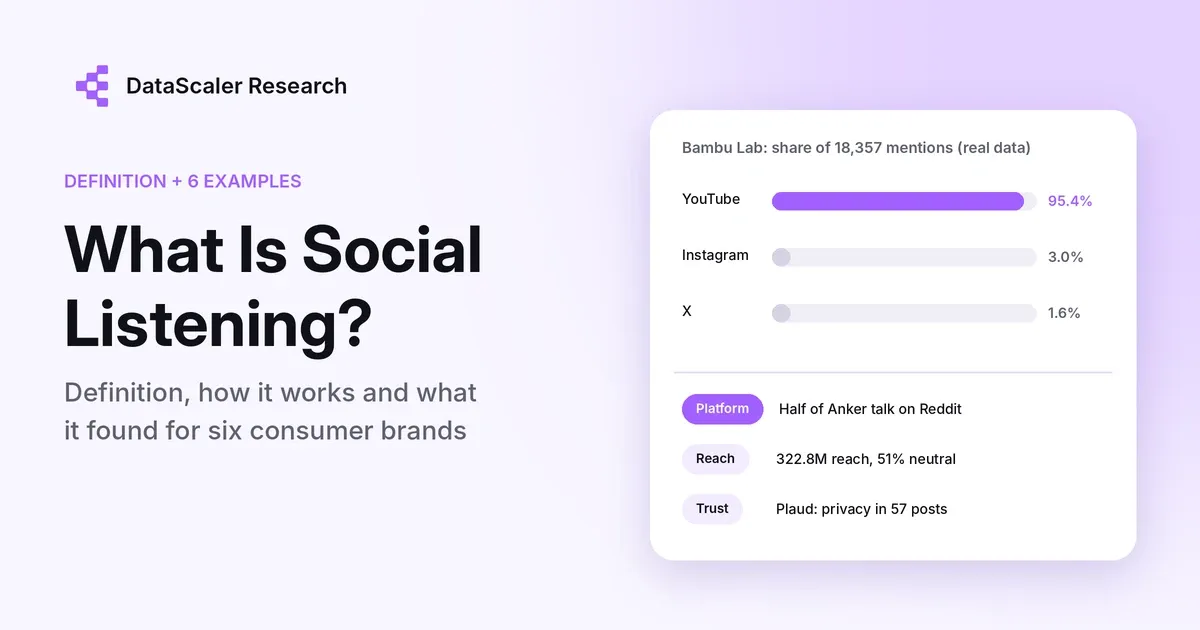
In a 90-day sample of 18,357 public mentions of Bambu Lab, the 3D printer brand, 95.4% came from YouTube. Instagram had a higher positive share (60%, against YouTube's 35%), but it held only 3% of mentions.
A brand-level sentiment score here is mostly a YouTube score in disguise. Before reading any average, check where the conversation actually happens. Read the case study.
2. Anker: half the conversation was on Reddit
Over one year, about 1,300 of Anker's roughly 2,500 brand mentions were on Reddit, more than TikTok, Instagram, Pinterest and YouTube combined. Reddit sentiment was 36% positive, 46% neutral and 18% negative.
For a technical product, the most detailed buyer conversation may sit on a platform the marketing team never posts on. Read the analysis.

3. Anker: one viral video, a different story
A single TikTok video about a 140W travel charger reached about 1.2 million views. Of the 28 comments that were relevant to the brand, 68% were negative.
A few high-reach posts can carry a very different tone from the brand's overall conversation, which is why social listening has to look at individual high-impact posts and not only totals. The video is covered in the same Anker analysis.
4. E-bikes: huge reach, unresolved doubts
Across 30 days of public e-bike conversation, posts reached about 322.8 million people. Yet 51% of mentions were neutral: comparisons and questions without a clear verdict. Price came up 260 times and safety 125 times.
Attention, in other words, is not the same as purchase confidence. The category does not need more awareness. It needs answers on price and safety. Read the report.
5. Plaud AI recorders: the blocker was trust, not demand
In a month of public conversation about Plaud, people called the product "useful" 85 times and "helpful" 67 times. They also raised privacy concerns in 57 posts, called it "redundant" 53 times and mentioned "subscription cost" 47 times.
Buyers wanted the product but hesitated over privacy, necessity and ongoing cost. Those are objections a listing, FAQ or onboarding flow can answer. Read the analysis.
6. Bambu Lab again: 3% negative posts, 60% negative comments
In 120 days of monitoring, only 3% of Bambu Lab posts were negative. Under the most-viewed video in the set, which had 494,000 views, 60% of the 146 comments we analyzed were negative.
Post-level sentiment can look calm while the comments underneath carry the real debate. Read comments on high-reach content, not just the posts. Read the brand monitoring guide.
What these examples have in common
Each finding came from looking one level below the summary number:
- Below the brand score to the platform split (examples 1 and 2).
- Below the totals to individual high-reach posts (examples 3 and 6).
- Below the reach figure to what people were actually unsure about (examples 4 and 5).
That is the core skill of social listening. The summary tells you where to look. The posts tell you what to do.
How to start social listening
- Write down two or three questions you need answered, such as "why are buyers choosing a competitor?"
- Choose sources by audience. Where do your buyers research? For many consumer products that means YouTube comments, Reddit and TikTok, not only X and Instagram.
- Track your brand, two or three competitors and one category topic.
- Review weekly, report monthly. Weekly for changes and risks; monthly for themes and decisions.
- Turn findings into a short report with the evidence linked. Our guide on how to build a social listening report people will use shows the format.
What you need from a social listening tool
You can start by hand with native search on Reddit, YouTube and TikTok. Once you track more than one brand or check more than once a week, a tool saves time. For consumer brands, four things matter more than the feature list: coverage of the platforms where your buyers research (YouTube comments, Reddit and reviews often matter more than X), comments read alongside posts, a click-through from every number to the posts behind it, and pricing that does not jump when you add competitors.
Our list of free social listening tools compares the free options and when it is worth paying for one.
See what social listening finds for your brand. Enter your brand in the free brand report to see platforms, themes and the posts behind them, or book a demo.
FAQ
What is social listening in simple terms?
It means paying attention to what people say about your brand, competitors and category online, figuring out why they say it, and using that to make better decisions.
What is an example of social listening?
A charger brand finds that about half of its online conversation happens on Reddit, where buyers discuss charging speed in detail. The team starts reading those threads and leads its product pages with tested charging scenarios.
Is social listening the same as social media monitoring?
No. Monitoring tracks mentions and flags ones that need a reply. Listening analyzes the patterns behind them, including competitor and category conversation, to guide product, marketing and sales decisions.
What platforms does social listening cover?
Typically X, Instagram, TikTok, YouTube, Facebook, Reddit, forums, blogs, news and review sites. Which matter most depends on where your buyers research. For many consumer products, YouTube comments and Reddit carry the most detail.
How long does it take to see results from social listening?
A first useful read can come within a week of setting up. Trends and the effect of changes usually need four to eight weeks of consistent tracking.
Methodology and sources
The six examples summarize DataScaler research published in 2026, based on public posts and comments over the windows stated in each original article: 90 days (Bambu Lab case study), one year (Anker), 30 days (e-bikes and Plaud) and 120 days (Bambu Lab monitoring). Sentiment and themes are model-classified. Counts are mentions or posts, not unique people or sales.
Want to know what people say about your brand, and why? Generate a free brand report, or book a demo.