
Monday’s competitor update arrives as twelve screenshots and four links. One rival has changed a bundle. Another is pushing a new claim. A negative review is circulating in Slack, but nobody has checked whether it is one loud post or a repeated customer problem.
By Friday, the channel is fuller. The decision is no clearer.
Competitor monitoring should do something more useful: show what changed since the last review, preserve the evidence behind that change, and name the person who will decide what happens next. For most ecommerce teams, a focused weekly review is enough. Daily alerts should be reserved for launches, safety issues, outages, or reputation risks that cannot wait.
This article is for brand, consumer insights, and product marketing teams. It focuses on three inputs they can use together: official product and offer changes, public customer conversation, and competitor messaging. It does not treat social discussion as proof of sales, market share, or product performance.
Start with one weekly competitor monitoring record
A watch list is not a monitoring system. The working unit should be one verified change, not one mention, screenshot, or alert.
Copy this table into a spreadsheet, Notion page, or weekly brief. Keep one row for every change that survives review.
Review field | What to record | Example |
|---|---|---|
Review window | Current period and comparison period | Sep 1–7 vs. Aug 25–31 |
Scope | Market, products, competitors, sources, inclusions, exclusions | US; entry-level printers; three named rivals; official pages plus public reviews and discussion |
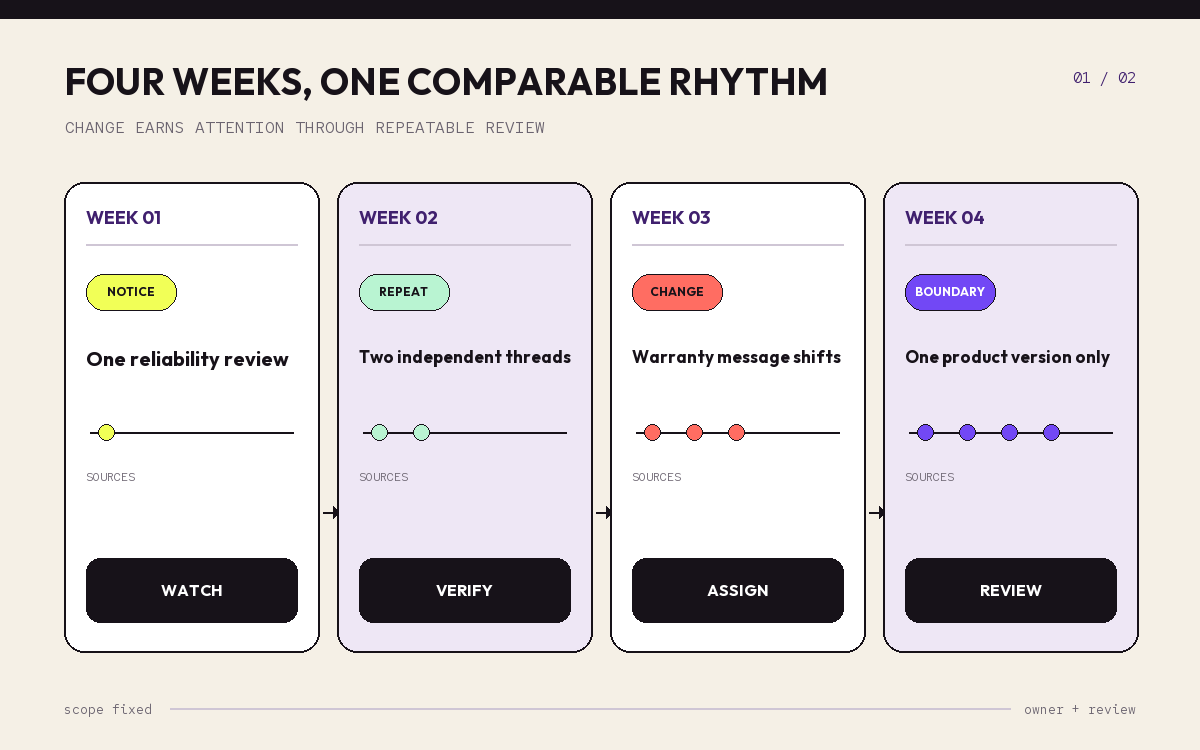
Observed change | A neutral statement of what is different | A rival changed its warranty message and “support” appeared in two new owner discussions |
Evidence | Original URLs, dates, source type, and independent-source count | Product page snapshot plus two unrelated public threads |
Boundary | What the evidence cannot establish | No evidence yet that the concern is category-wide or affects sales |
Status | Watch, verify, escalate, or close | Verify |
Owner and next action | The person or function making the next decision | Product marketing checks the claim; support reviews known cases |
Review date | When the change will be checked again | Sep 14 |
This record answers the practical definition of competitor monitoring: a repeatable process for finding meaningful competitor changes, checking the sources, and routing the result to an owner.
Use the ecommerce competitor analysis framework when you need to compare a market or offer from scratch. Use this weekly record after the comparison scope has been set and the team needs to notice what changed.
Track three types of change—not everything a competitor does
The broadest monitoring plans are usually the least useful. An ecommerce team can begin with three change groups tied to decisions it actually owns.
Change group | Questions worth monitoring | Strong starting evidence | Likely owner |
|---|---|---|---|
Product and offer | Did a price, bundle, warranty, shipping promise, feature, compatibility claim, or availability status change? | Official product pages, retailer listings, terms, ads, release notes | Product marketing, ecommerce, commercial |
Repeated customer friction | Are buyers or owners repeating a new problem around reliability, setup, support, safety, fit, value, or switching? | Public posts, comments, communities, and reviews, checked at source level | Consumer insights, product, support |
Competitive narrative | Is a new comparison, use case, creator angle, or value claim appearing across more than one source? | Campaign pages, creator content, public discussion, search and social creative | Brand, content, growth |
The three groups need different evidence. A competitor’s product page can confirm that a warranty changed. It cannot tell you whether owners find the new promise credible. A viral review can reveal a question worth checking. It cannot prove that the question is common.
That distinction is where DataScaler fits. The current Brand Monitoring solution groups public posts, comments, communities, and reviews into source-linked findings. Official product, pricing, and ad changes should still be checked in the systems that publish them.
Ask “is it new?” before asking “is it important?”
A spike is only new relative to a stable baseline. Before the first weekly review, freeze the competitors, products, market, language, sources, query terms, exclusions, and comparison window. If the scope changes later, version it. Otherwise a new platform or broader keyword can look like market movement.
Then run five checks:
Check | Review question | Failure signal |
|---|---|---|
Relevance | Is the item really about the tracked brand, product, market, and question? | A shared word or model name creates false matches |
Independence | How many unrelated source posts or pages support it? | Reposts, syndication, or comments from one parent item are counted as separate experiences |
Context | Does the surrounding post, comment, or product version change the meaning? | A keyword is treated as positive or negative without reading the source |
Cross-source pattern | Is the change distributed across sources, or driven by one platform or creator? | One high-reach item determines the headline |
Decision impact | If the pattern is confirmed, what action could change? | Nobody can name an owner or next decision |
Only after those checks should the team assign a status:
- Watch: new, but supported by too little independent evidence;
- Verify: repeated enough to inspect the product version, customer context, or official claim;
- Escalate: credible, decision-relevant, and owned by a team that can respond;
- Close: explained, no longer recurring, or outside the agreed scope.
Thresholds should start an investigation, not generate an automatic conclusion. “Complaints doubled” is not useful without the original count, relevant-sample total, platform mix, and time window. Ten reposts of one video are not ten independent customer experiences.

Bambu Lab example: platform concentration changes the review
DataScaler’s frozen Bambu Lab research offers a useful monitoring lesson without pretending to be a full competitor benchmark.
Dataset DS-BAMBU-2026-01 covers a 90-day collected-time window from May 29 to August 27, 2026. It separates 655 public source posts from 18,357 displayed post-and-comment mentions. Of those mentions, 17,511—or 95.4%—came from YouTube.
Observed signal | What the fixed research can support | What the weekly record should say |
|---|---|---|
YouTube supplied 95.4% of displayed mentions | The sample is especially useful for video-led reviews, demonstrations, comparisons, and comment-section questions | “Video evaluation dominates this sample; check whether the same issue appears elsewhere before making a market-wide claim” |
“Reliability” appeared in both positive and negative theme lists | The word is being used in different contexts and needs source review | “Reliability is a mixed theme, not a negative finding by itself” |
The positive source panel returned records, while the negative panel returned zero posts during the audit despite 36 aggregate occurrences | The aggregate signal could not be reconciled with visible negative source records at that time | “Hold the negative claim; request export-level reconciliation before escalation” |
The useful output is not “Bambu Lab has a reliability problem.” It is: the observed reliability signal is mixed, heavily shaped by YouTube, and partly blocked by a source-level data gap. Keep it in verification until the underlying records support a narrower conclusion.
That is what Research contributes to monitoring: a fixed window, clear sample units, visible denominators, and a documented limitation. Read the full Bambu Lab social listening research for the method, source register, and platform breakdown.
Route the finding to the owner who can close it
An analyst should not be the permanent owner of every competitor signal. Their job is to make the evidence reviewable and send it to the function that owns the decision.
- A verified price, bundle, or shipping change goes to ecommerce or commercial leadership.
- A recurring setup or reliability question goes to product or support.
- A comparison claim that is spreading across creator content goes to brand or product marketing.
- A possible safety or legal issue goes to the relevant risk owner immediately, even when the public sample is still small.
The handoff needs a sentence, not another dashboard: what changed, which sources support it, what remains unknown, who owns the next action, and when the signal will be reviewed again.
On the next review date, record the result. Did the pattern spread to independent sources? Did the owner confirm a product fact? Did a response change the conversation? If nothing changed, close or narrow the watch. Monitoring without closure becomes an archive.
For deeper interpretation—alternative explanations, evidence grades, and decision-ready reporting—continue with the competitive intelligence analysis method.
When a spreadsheet stops being enough
A spreadsheet and a few native searches may be sufficient when the team monitors two or three competitors in one market, reviews weekly, and can preserve every source without rebuilding the work.
A monitoring platform starts earning its place when:
- the same scope must be rerun across several weeks, markets, or languages;
- public posts, comments, communities, and reviews exceed what one analyst can inspect manually;
- duplicate items and platform concentration regularly distort the headline;
- several owners need the same evidence, history, and review status;
- the team spends more time reconstructing sources than discussing the decision.
Test | Manual workflow is still enough | A platform is becoming useful |
|---|---|---|
Scope | One market, a few competitors, stable sources | Multiple markets, products, languages, or source groups |
Evidence | Every finding can be linked and checked manually | Links, comments, and context are repeatedly lost |
Refresh | An analyst can reproduce the same query and period | Each update requires rebuilding the dataset |
Collaboration | One owner reviews the result | Several teams need assignments, history, and follow-up |
Do not choose a competitor monitoring tool by dashboard count. Test whether it preserves the scope, source trail, denominator, owner, and review date. The free social listening tools comparison includes a 30-minute evidence test that can be reused here.
How often should ecommerce teams monitor competitors?
Review routine product, offer, customer-friction, and message changes weekly. Use daily review only during active launches or for high-impact safety, outage, legal, or reputation issues. Reassess the competitor set and source design quarterly.
Is competitor tracking different from competitor monitoring?
The terms are often used interchangeably. “Tracking” may describe collection; “monitoring” should include comparison, source verification, ownership, and follow-up. A feed of alerts is tracking activity, but it is not yet a decision system.
Run the same check on your own brand
DataScaler turns public posts, comments, communities, and reviews into a short brand report with source drill-downs. Enter a brand name or website; DataScaler identifies competitors and generates an initial set of topics for review.
Start with one question: which customer concern keeps returning, and can I open the conversations behind it? If the report cannot help answer that question, adding more alerts will not make the monitoring system better.