
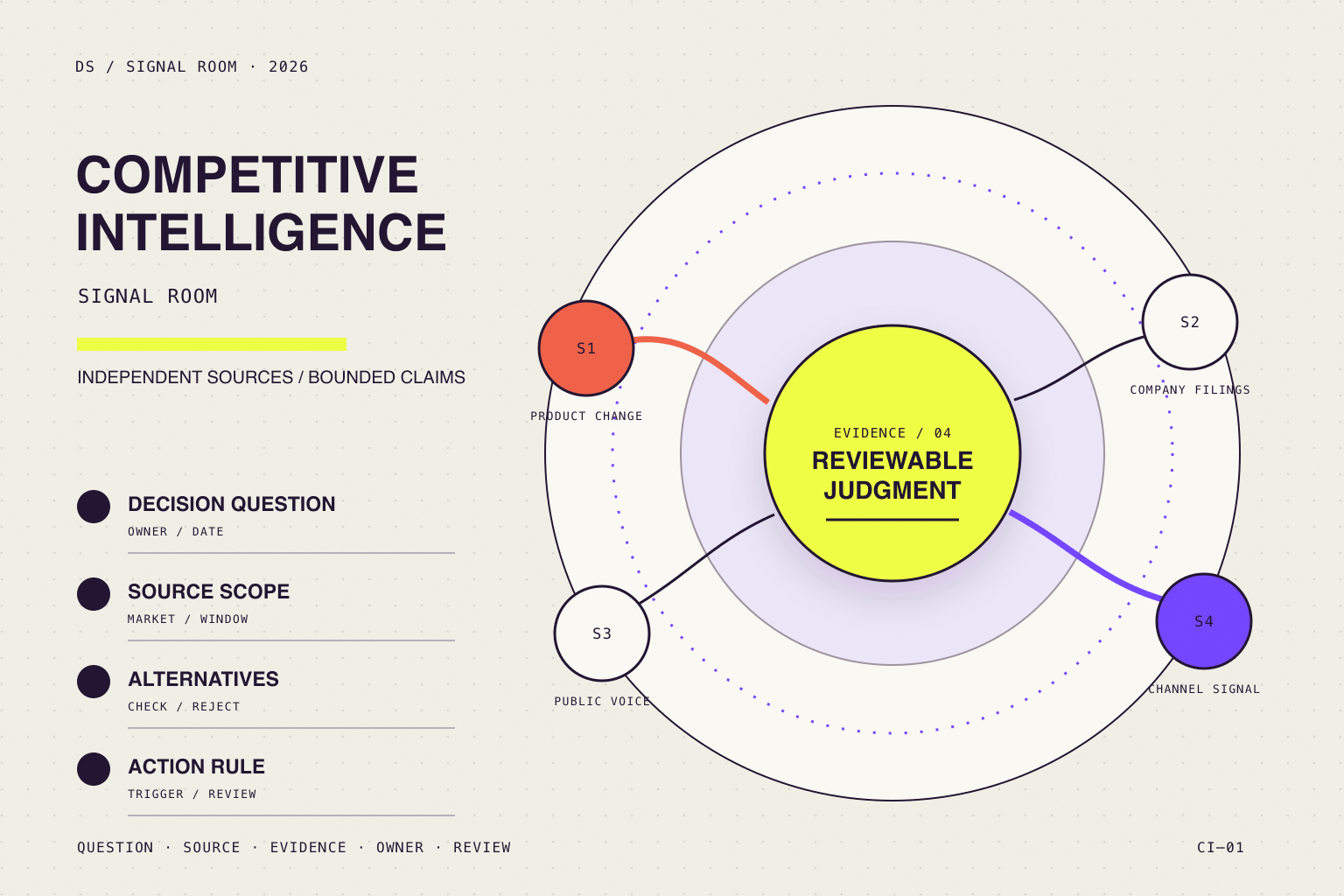
If a weekly competitor update contains 30 screenshots and no decision, the team has collected information—not intelligence. Competitive intelligence analysis starts with a question someone owns, tests the available evidence, records what remains uncertain, and ends with a next step and review date.
This guide is for product marketers, competitive intelligence leads, strategy teams, and ecommerce operators who need to explain a competitor move without overstating what public data can prove.
Quick answer
Competitive intelligence analysis is the process of turning legally and ethically collected market and competitor information into a decision-ready judgment. A practical process has six parts: frame the decision, plan the sources, capture evidence with dates and scope, distinguish signals from findings, test alternative explanations, and assign an action with an owner and review date.
The output is not a feed or a slide deck. It is a short decision record that shows what changed, which sources support the finding, how confident the team is, what the evidence cannot establish, and what happens next.
What is competitive intelligence analysis?
Competitive intelligence analysis evaluates changes in competitors, customers, channels, and the market so a specific decision-maker can reduce uncertainty. It can examine product launches, positioning, pricing, partnerships, hiring, distribution, customer objections, reputation risks, or category shifts.
The word “analysis” matters. Monitoring detects an event. Collection preserves the material. Analysis compares explanations and decides whether the signal is relevant enough to act on.
DataScaler Brand Monitoring covers one part of that system: it tracks public brand and competitor conversations, groups recurring themes, and keeps the original posts, comments, and reviews attached to each finding. Company filings, product pages, first-party data, sales conversations, and specialist research remain separate sources with different boundaries.
Competitive intelligence analysis vs. competitor analysis
The terms overlap, but their operating scope is different.
Competitor analysis | Competitive intelligence analysis | |
|---|---|---|
Primary purpose | Compare a defined set of competitors | Reduce uncertainty around a business decision |
Typical scope | Products, prices, offers, channels, messaging | Competitors plus customers, market structure, regulation, partnerships, and internal evidence |
Time pattern | Snapshot or scheduled comparison | Continuous cycle of questions, collection, analysis, action, and review |
Deliverable | Comparison matrix or profile | Evidence-backed judgment with confidence, owner, and review trigger |
Main risk | Comparing unlike offers | Treating a signal or assumption as established fact |
For product, price, promotion, and customer-signal comparisons, use the more focused ecommerce competitor analysis framework. Competitive intelligence analysis sits one level above it: it decides which questions matter, which sources deserve weight, and when a comparison should change a plan.
Start with one intelligence question
“What are our competitors doing?” is too broad. It produces a large collection and a weak conclusion. Start with a question tied to a real decision and a named user.
Useful questions look like these:
- Is the competitor’s new bundle changing how buyers define value, or is attention concentrated around launch coverage?
- Which repeated objections could weaken our product positioning during the next launch?
- Does the competitor appear to be entering a new segment, and which evidence would confirm or reject that interpretation?
- Which customer question is the competitor becoming known for answering?
Good intelligence begins with a decision-maker’s problem and a question narrow enough to answer. The question should reduce uncertainty, not invite every available fact into the document.
Record five fields before collection begins:
Field | Example |
|---|---|
Decision | Whether to revise launch comparison messaging |
Decision owner | Product Marketing Lead |
Intelligence question | Is the competitor winning on price, bundle clarity, or customer proof? |
Deadline | Before launch copy lock on September 18 |
Decision rule | Revise the comparison if the pattern appears across at least three independent sources and persists for two reviews |
The decision rule is not a universal statistical threshold. It is an internal agreement about what evidence would justify action.
Build a source plan before opening the tools
Competitive intelligence research should begin with a source plan, not a search box. The source mix should follow the question; no single database supplies a complete view.
Source layer | What it can support | Examples | Boundary |
|---|---|---|---|
Competitor-controlled | What the company says or has changed | Product pages, pricing, help docs, press releases, job listings | Shows stated offer or intent, not customer response |
Regulatory and financial | Material company facts and reported performance | SEC filings, regulatory notices, official tenders | Availability varies by company and jurisdiction |
Customer and public conversation | What people repeatedly ask, praise, compare, or reject | Public posts, comments, communities, reviews | Does not represent every customer or prove sales impact |
Market and channel | How the offer appears in distribution and discovery | Retail listings, search results, ads, partners, resellers | Often changes quickly; capture date matters |
First-party internal | What your own customers and teams observe | CRM, support, win/loss, sales notes, surveys | Different population and permissions; do not blend silently with public data |
Need the actual source links? The competitive intelligence sources guide lists seven places to start and explains what each can—and cannot—tell you.
For public companies, the SEC provides free access to filings through EDGAR. The filing date, period, form type, and company statement belong beside any extracted claim.
Keep the source layers separate until the analysis stage. A repeated support ticket and a repeated public review may point to the same issue, but they come from different populations and collection rules.
Use a six-stage competitive intelligence process
1. Frame the decision.
Write the intelligence question, owner, deadline, competitor set, market, and time window. State which outcome could change. If no possible answer would affect a decision, the work is probably a monitoring task rather than an analysis project.
Still deciding which products belong in the comparison? Use the direct competitor identification guide to build the shortlist first.
2. Capture dated evidence.
Save the source URL, publication or capture date, market, product, and relevant excerpt or observation. Preserve the original context. A cropped screenshot without its URL and date becomes evidence debt the moment it enters a deck.
3. Classify the signal.
Separate the observation from its interpretation. “Mentions increased 40%” is an observation under a stated query and window. “The competitor is gaining market share” is a much broader claim that public conversation alone cannot establish.
4. Test alternative explanations.
Before accepting a finding, ask what else could produce the same pattern. A launch, creator partnership, giveaway, customer complaint, query change, or single viral post can all increase attention. Check source concentration, platform mix, independent-source count, and whether the signal persists.
5. Write a bounded finding.
A finding should contain the observed change, the strongest evidence, the most plausible interpretation, confidence, and a limitation. Avoid pretending uncertainty has disappeared.
6. Assign the decision and review.
Name the owner, the immediate action, the metric or evidence to watch, and the next review date. “Continue monitoring” is only an action when the scope, trigger, owner, and date are explicit.
Copy this competitive intelligence report template
A useful competitive intelligence report records a judgment, not a list of links. Use the fields below for one question at a time. The filled example asks whether Anker’s lead in monitored conversation is enough to justify changing a competitor comparison page.
The counts come from DataScaler’s published Anker benchmark, based on a dashboard screenshot captured on September 15, 2026. The decision and review plan below are worked examples—not actions taken by Anker or a client.
Report field | Filled Anker example |
|---|---|
Intelligence question | Does Anker’s lead over Ugreen justify changing our competitive messaging? |
Scope | The configured Anker, Ugreen, Belkin, and mophie comparison for August 16–September 15, 2026. Unit: monitored posts. Do not mix this view with the separate one-year brand baseline. |
Observation and source | The published benchmark records 1,065 Anker posts and 849 Ugreen posts within a four-brand total of 2,793. That is 38.1% versus 30.4%, a gap of 216 posts. These are screenshot-derived aggregate counts, not independently audited source records. |
Bounded finding | Anker leads this monitored set in this period. The view does not establish growth, stronger buyer preference, or market share. Anker’s comparable prior-period count is missing. |
Evidence grade | C — directional for the proposed messaging decision. The aggregate snapshot identifies a question to investigate; it does not establish why the gap exists. |
Alternative explanations | Competitor decline, a launch, creator coverage, or a change in platform mix could produce the gap. None has been established by these counts. |
Decision and owner | Product Marketing keeps the current comparison claim unchanged. The CI analyst checks which products, platforms, and independent sources account for the gap, then compares Anker’s absolute count with the preceding period under the same collection rules. |
Review and release condition | Review within seven days of starting the investigation. A dated, source-linked explanation and a comparable prior period are required before proposing a messaging change. If either is missing, record “unresolved”; do not turn the snapshot into a growth claim. |
The useful outcome here is a decision not to strengthen a claim yet. A 216-post lead tells the analyst where to look. It does not tell the marketer what caused the lead or what customers will buy.
Reuse the field names for your own report. Replace every number, date, source, owner, and review condition; do not carry this example’s evidence grade into a different decision.
For a model-specific view of the buyer questions behind this example, read the Anker vs Ugreen charging case study.
Signal, finding, and decision are not interchangeable
The cleanest way to improve competitor intelligence analysis is to keep these three records separate.
Record | Bambu Lab example | What it means |
|---|---|---|
Signal | 17,511 of 18,357 mentions in a fixed 90-day sample came from YouTube | The sample is highly concentrated on one platform |
Finding | The visible conversation in this sample is shaped strongly by YouTube posts and comments | Cross-platform totals must be interpreted with the platform denominator beside them |
Decision | Review independent sources and the next comparable period before changing positioning | The team treats the result as a bounded hypothesis, not a market-wide conclusion |
The figures come from DataScaler’s fixed Bambu Lab social listening research. They describe that archived dataset, not every customer, platform, or market.

Add a simple evidence grade
Evidence grades make disagreement visible. They should describe support, not make weak material look scientific. One of the most useful competitive intelligence best practices is to agree on these grades before a high-stakes finding reaches the meeting.
Grade | Working definition | Suitable use |
|---|---|---|
A — Direct | Primary source or directly observed change with date and scope | Establish that an event, offer, filing, or statement exists |
B — Corroborated | Pattern supported by several independent sources or source types | Support a bounded finding |
C — Directional | Single source, estimate, early pattern, or concentrated platform signal | Create a hypothesis and define what to check next |
D — Unverified | Summary without accessible source or context | Do not use for a decision until verified |
Confidence should reflect both evidence quality and the number of plausible alternative explanations. A direct source proves that a competitor changed a page; it does not prove why the company changed it or how customers will respond.
Match the review cadence to the decision
Cadence | Review | Avoid |
|---|---|---|
Daily | Alerts, outages, campaign reaction, high-risk reputation events | Rewriting strategy from one spike |
Weekly | Launch signals, repeated objections, channel shifts, competitor content and offer changes | Treating a weekly sample as a long-term trend |
Monthly | Theme persistence, positioning patterns, share-of-voice context, win/loss hypotheses | Mixing different scopes without labeling the break |
Quarterly | Competitor set, category assumptions, strategic hypotheses, source coverage | Carrying old conclusions forward without retesting them |
The social listening report guide shows how to package one review into a readable report with scope, evidence, owners, and dates.
What should competitive intelligence analysis tools provide?
A useful tool does not need to answer every question. It should make the evidence it handles easier to inspect and reuse.
- repeatable brand, competitor, market, source, language, and date scopes;
- source links and capture dates attached to findings;
- comparison across competitors, themes, platforms, and periods;
- a way to distinguish volume from independent-source support;
- saved findings, owners, decisions, and review dates;
- exports or reports that preserve evidence boundaries;
- clear disclosure of what the dataset includes and excludes.
DataScaler supports the public-conversation layer: brand and competitor monitoring, recurring customer themes, source-level posts and comments, and a short report for review. It does not replace filings, first-party research, sales data, or legal review.
Keep collection legal and ethical
Competitive intelligence should use authorized and appropriately handled sources. Do not misrepresent identity, bypass access controls, solicit confidential competitor information, or mix restricted personal data into a shared report.
The U.S. Federal Trade Commission notes that companies may collect price and other competitive information from public sources such as trade journals, securities filings, and press releases. It also warns that exchanges involving current or future competitor plans can raise competition concerns. See the FTC’s guidance on dealings with competitors and public-source information. Requirements vary by jurisdiction and situation; involve counsel when collection or sharing is sensitive.
FAQ
What are the main steps in competitive intelligence analysis?
Frame the decision, build a source plan, capture dated evidence, classify the signal, test alternative explanations, write a bounded finding, and assign an owner and review date. The collection and analysis stages can repeat before a decision is made.
How is competitive intelligence different from market research?
Market research usually studies customers, demand, or category conditions through a defined research design. Competitive intelligence is organized around decisions involving competitors and the market, and it combines ongoing monitoring with targeted analysis. The two can share sources but should not erase differences in method or population.
Why is competitive intelligence analysis important?
It gives teams a shared way to test competitor signals before changing positioning, product plans, or channel priorities. The source trail and review trigger also make it easier to correct a judgment when new evidence appears.
How is competitive intelligence used in marketing?
Marketing teams use it to examine positioning changes, buyer questions, competitor proof, channel activity, launch response, and repeated objections. The useful output is a testable implication for messaging or campaign planning, not a collection of competitor creative.
How often should competitive intelligence be updated?
Use daily monitoring for urgent events, weekly review for launches and repeated signals, monthly analysis for persistent patterns, and quarterly review for strategic assumptions and competitor sets. The decision determines the cadence.
Can social listening prove that a competitor is gaining market share?
No. It can show public attention, recurring language, platform distribution, and source evidence under a defined scope. Market share requires appropriate sales, shipment, panel, or financial data.
How many competitors should an analysis include?
Use the smallest set that can answer the decision. Three to five comparable competitors is often workable for a focused review, with substitutes or category leaders kept in a separate group when needed.
Method note
This article describes an operating framework, not a universal research standard. Evidence thresholds should be set for the cost and reversibility of the decision. Public-conversation examples cover only the sources, queries, languages, markets, and dates stated in the linked report.