
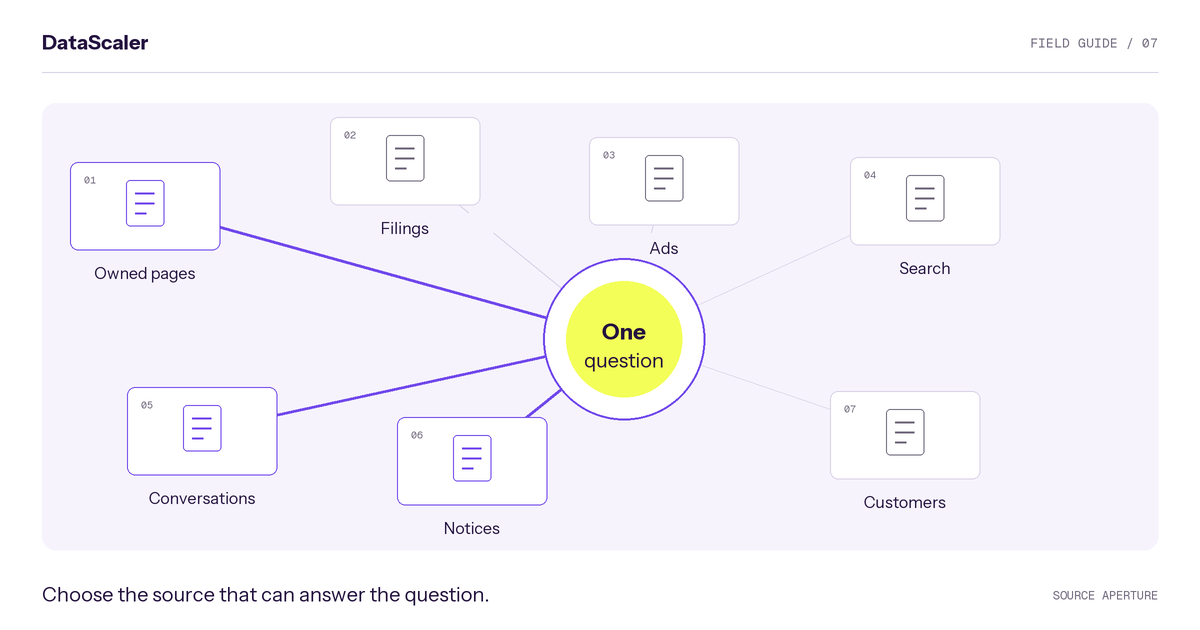
To check a competitor's price, start with its product page. To find out why someone hesitates to buy, read what they ask in reviews and discussions. These sources answer different questions, so it helps to decide what you need before opening another report.
Consumer brands have seven useful sources of competitive intelligence: competitor websites, public filings, ad libraries, search-interest data, public conversations and reviews, regulator notices, and their own customer records. This guide is for product marketers and customer researchers who need to find and check that information.
Where to find competitive intelligence
The directory groups sources by the information they provide; it doesn't rank software. Access and available details vary by market. You'll need permission to use internal customer records.
Source | Where to look | What you can learn | Details to keep |
|---|---|---|---|
1. Competitor websites | Product, pricing, help, and announcement pages, such as Anker's official notices | The company's published specifications, offers, and statements | Page URL, model, market, publication date, date checked |
2. Public filings | SEC EDGAR, for companies that file with the SEC | Information the reporting company has formally disclosed | Legal company name, filing type, reporting period, filing date |
3. Ad libraries | Available ad creative and product claims | Advertiser or website, region, date filters, creative, landing page | |
4. Search-interest data | Relative search interest for a term or topic | Term or topic, geography, date range, search type | |
5. Public conversations and reviews | Original posts, review pages, and records with source links in DataScaler | What people say in the collected discussions and what they're responding to | Original URL, publisher, product, date, platform, whether the record is a post or comment |
6. Regulator notices | CPSC recalls for relevant US consumer-product notices | The regulator's action and the products it covers | Jurisdiction, notice number, date, affected models |
7. Your own customer records | Authorized support records, interviews, returns, and win/loss notes | What your customers and prospects reported or did | Collection method, product, customer stage, reason, total people or cases counted |
What to check before using a source
1. Competitor websites: read the full offer
For a charger comparison, open the model's product page and note its output conditions, included cable, price, currency, and warranty. Check that you're comparing the same regional offer and bundle before calling one price lower than another.
Save the wording and the date you checked it. To report a price cut, you'll also need a comparable earlier offer. The current page alone won't tell you when or why it changed, or why someone bought it.
2. Public filings: check which company you're reading about
Start with the legal company name in EDGAR. A group may own several brands, so its revenue won't necessarily tell you how one brand, product line, or SKU performed. Keep the reporting period and filing date separate. The SEC's search page lists the available search options.
If the company hasn't disclosed the breakdown you need, mark it as unavailable. More social mentions won't fill in the missing revenue figure.
3. Ad libraries: see how competitors describe their products
In Google's Ads Transparency Center, search for the advertiser or website, then set the dates and target location. Google's documentation explains the filters and notes that available disclosures vary by location.
Follow a claim through to its landing page. Do the model and usage conditions support what the ad says? That's useful research for a messaging brief. The creative alone won't tell you whether the ad was profitable, how well it converted, or what the advertiser spent worldwide.
4. Google Trends: use the same settings
Keep your choice of terms or topics, geography, dates, and search type consistent. Google uses sampled data, normalizes it, and displays relative interest on a scale of 0 to 100. That isn't an absolute search count or a sales figure; Google's data explanation describes the calculation.
If you spot a peak, check announcements and discussions from that period. A launch, promotion, or recall might explain it, but you'll need dated sources to make that connection.
5. Public conversations: open the original post
A topic such as "charging speed" can cover a happy new owner, someone asking about cable compatibility, or a complaint after months of use. Each calls for a different response from marketing, support, or product. Reading the post helps you decide who needs to see it.
Keep the URL, product, date, and platform, and note whether you're citing the main post or a comment. Check for repeats too: several records may come from one creator or quote the same announcement.
6. Regulator notices: check the models and market
Keep the model numbers, market, and date with any recall reference. The brand and the regulator may publish related notices on different dates, as the Anker example below shows.
Limit your conclusion to the products named. Claims about other products' quality, or the reasons for later negative discussion, need their own evidence.
7. Internal customer records: ask support and sales
When public posts raise a compatibility question, check whether your customers have asked it too. Request relevant, authorized records from the support or research team and remove unnecessary personal information before sharing them.
Keep interviews, support tickets, returns, and sales notes separate in your counts. They reach you through different processes. A customer mentioning a competitor hasn't necessarily decided against you, and your records can't establish that competitor's overall return rate.
A Bambu P1S buyer's question
We found a September 1, 2026 Threads post through DataScaler's API and checked its wording and date on the original page. Someone shopping for a first 3D printer wanted to know whether the P1S would be easy and dependable. They also asked: "Anything comparable or potentially better for less money?"
If we were updating a comparison page for this reader, we'd explain the setup, the cost of buying what they need, and where to get help. Print speed and build volume still belong on the page, but they leave those questions unanswered.
What the buyer cares about | Where to check | What to write on the comparison page |
|---|---|---|
Can a beginner use it? | The model's setup guide and a recorded first-print walkthrough | The steps from unboxing to a first print, including manual tasks; label vendor claims and tested results separately |
What will it cost to get started? | Current official offers for the same region and equivalent bundles | List the printer, included items, and required extras separately, with the date checked; don't compare a bare printer with a full bundle |
How much upkeep does it need? | Warranty and support terms, maintenance instructions, and ownership accounts with original links | Explain what support covers and what the owner maintains; leave out failure-rate rankings unless you have the data |
A product marketer can draft this section and ask a product specialist to check the setup and bundle details. After publishing, track whether readers continue to the comparison or product pages.
DataScaler helped us find the question and keep the original post available for checking. We'd still turn to official product information for prices, specifications, and instructions. This one post tells us someone asked; a larger sample would be needed to judge how common the question is.
Sample note: the post was collected on September 3 and retrieved for this article on September 24. The account's latest collection finished on September 13. We treat this example separately from the fixed research sample below and don't use it to describe this week's demand.
Dates need a second look too. Anker's official directory lists A1647, A1652, A1257, A1681, and A1689 under June 2025, while the related US CPSC notice 25-466 was published on September 18, 2025. Keep the source, date, and jurisdiction with each reference instead of counting them as unrelated incidents. These are historical notices; they don't explain later social sentiment. For recall eligibility and product handling, follow the official instructions.
Several links may lead back to one source
Five articles repeating an announcement can tell you where it spread. They aren't five independent accounts of using the product. Record the number of links and the number of independent sources separately.

The diagram is an illustration, not measured Anker or Bambu data. Mark an unclear origin as unconfirmed until you can trace it.
Check where the sample comes from as well. DataScaler's fixed Bambu Lab research covers 655 source posts collected from May 29 to August 27, 2026. Including comments, there are 18,357 mentions, 95.4% of them from YouTube.
That gives a product marketer a place to look for buying questions under reviews and demonstrations. To estimate satisfaction across all customers, you'd need a different sample. Adding more YouTube comments would still leave other groups unrepresented. Keep post counts separate from counts that include comments.
When building a competitor benchmark, check the dates, whether each figure counts posts or comments, and whether two charts reuse the same records before comparing their numbers.
Choose sources for the work in front of you
For a comparison page, gather the specific model's official details, relevant ads, and buyer questions. The product marketer writes the copy; the analyst checks that the products and markets match.
To investigate hesitation about a purchase, have the customer research team read the public posts and ask support for related tickets or interviews. Keep the two groups separate in your counts instead of combining them into one sentiment percentage.
For a product event, check the brand's and regulator's notices first, then read reactions published around that time. A claim that the event changed buying decisions needs evidence of those decisions too.
Keep a table of URLs, publishers, products, markets, publication dates, and dates checked. Note what each number counts and what you plan to use it for. Once the sources answer your question and there are no relevant gaps left to fill, start writing. The competitive intelligence analysis guide covers the analysis and report.
DataScaler helps you find public discussions about brands and competitors and check the original posts. The filings, ad records, regulator notices, and internal customer records in this guide need to be gathered separately.
Explore your brand in DataScaler and start by reading a discussion about your product.
Common questions about competitive intelligence sources
What are the best free sources of competitive intelligence?
Official competitor pages, public filings, public ad records, Google Trends, and regulator notices have free entry points, though their coverage differs. Check the access terms for conversation tools and research services separately.
What is the difference between internal and external sources?
Competitor statements and public reviews are external sources. Your own interviews, support tickets, and business records are internal sources and require permission to use. Explain the groups and collection methods separately when analyzing them.
Can AI summaries serve as the source?
A summary can help you find material. Before citing it, open the original and check the statement, date, model, and market. Several summaries citing the same page still count as one original source.
When is there enough evidence to act?
It depends on the task. A current official page may be enough to correct a specification. Claims about demand, reliability, or market share need data that can answer those questions. Counting links won't tell you whether you have it.
Sources checked on September 24, 2026: official documentation, published research, and the selected post above. We haven't collected fresh data from every service listed. The suggested page changes haven't been tested for customer results.