
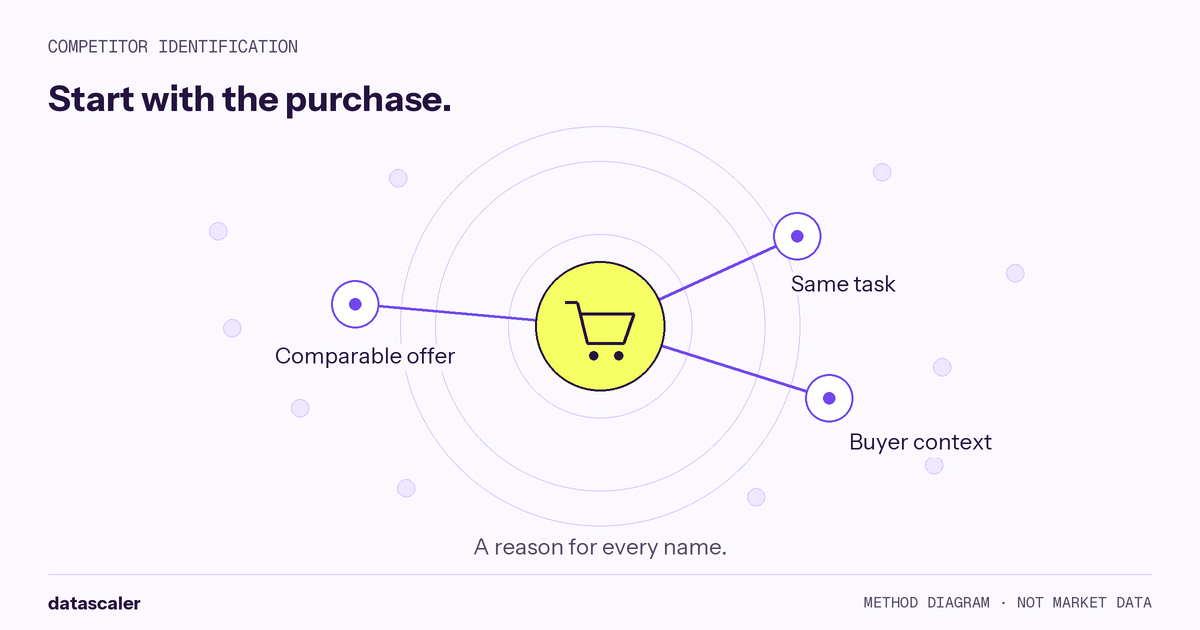
Before comparing prices, reviews, or social mentions, decide which products belong in the comparison. Otherwise, a competitor report can spend weeks tracking a well-known brand that rarely competes for the purchase you care about.
To identify direct competitors, find similar products that the same buyer could choose for the same task in the same market. Define that purchase, collect candidate products, check their fit, and keep a source-backed reason for each inclusion.
A buyer explicitly comparing two models is useful evidence. It is not a prerequisite. You can also shortlist products from their documented fit, as long as you do not present your selection as a customer's stated choice.
This guide is for product marketers and insights teams at consumer brands. We will build a working shortlist using public Bambu Lab discussions collected in DataScaler and a separate check of manufacturer product pages.
1. Define the purchase you are studying
Start with one product line and one buying situation. “Our competitors in consumer electronics” will produce a different—and much less useful—list than “alternatives to our compact charger for daily commuting.”
Write a short brief:
We want to understand the alternatives a US home user could consider for everyday desktop 3D-printing projects. Start with products for PLA/PETG printing. Compare equivalent packages before evaluating total cost.
The buyer, use, and market are explicit. A specific budget, a need for larger objects, or a requirement to print different materials would change the list.
This is an example research brief, not a description of everyone buying a printer. Your own brief should reflect the product decision your team needs to make: a launch, a comparison page, or a positioning update.
2. Find candidate products in three passes
Search the task, not just your brand. Try the category plus the buyer's constraints: “desktop 3D printer for home projects,” for example. Use search and marketplace results to find models worth checking. A ranking position is a discovery aid, not proof that a product is a close competitor.
Look for alternatives in the customer's own words. Search discussions for phrases such as “[model] alternatives,” “[model] vs,” “replacing my [model],” and “something cheaper than [model].” In authorized customer interviews or support records, ask what the person considered before choosing. Save the surrounding question, not just the brand name.
Open the exact product page. Check the model, region, included accessories, intended use, and relevant limitations. Comparing one brand's basic package with another's fully equipped bundle can create a price difference that disappears once the packages match.
Keep a candidate even if you have not found a buyer discussion yet; mark how you found it. The competitive intelligence sources guide covers the wider collection process. Here, we are using those sources to decide who belongs on the list.
3. Separate direct competitors from substitutes and search rivals
For each candidate, ask four questions: Does it serve the same buyer? Can it do the same job? Is it a similar kind of product? Is it a realistic option in that market, given price, delivery, and service?
Use those answers to separate the following groups.
Group | Reason to include it | Where it belongs |
|---|---|---|
Direct competitor | A similar product that is a plausible alternative for the defined buyer and task. | The product-comparison shortlist, with the relevant model and market. |
Indirect competitor | A different way to meet the same need. For example, paying for a print instead of buying a printer. | A separate substitutes list, when outsourcing fits the buyer's purpose. |
Search or attention rival | A publisher or creator reaches the same audience but does not sell a substitutable product. | Content and distribution research. |
Incidental mention | A brand appears in a sponsor credit, generic affiliate footer, or unrelated tag. | Not enough on its own for inclusion in the product shortlist. |
The outsourcing example depends on the job. If someone wants a finished object, a print service may substitute for owning a printer. If they want to learn printing at home, outsourcing does not provide the same experience.
Do not wait for every field to be complete before starting research. Use “include,” “investigate,” or “exclude,” and write down the reason. A product-fit decision and an observed buyer comparison are different kinds of evidence; both can be useful.
4. A worked example: reading the Bambu Lab evidence
The following social examples come from stored public-post text in a DataScaler snapshot retrieved September 24, 2026. We used them to make research decisions, not to rank printer brands.
A buying question tells us what the comparison must answer. In a September 1 Threads post, someone considering a Bambu Lab P1S asks for a straightforward printer for home projects and wonders whether a comparable option would cost less.
The post does not name a rival. It does give a PMM three useful comparison criteria: getting started, reliability, and total cost. Keep those criteria when finding alternatives. Do not replace them with whichever specifications are easiest to put in a table.
A creator supplies a comparison lead. An August 30 TikTok caption pairs a model called “Creality i7” with the Bambu Lab A1 and asks viewers to follow for the results. Similar wording appears in the saved Instagram and YouTube records from that day.
That gives us a product pair to investigate. Keep the three links together as a possible repost group until their origins are checked; they are not three independent buyer comparisons.
Product pages let us make an analyst selection of our own. Separately from that caption, we checked the officially named Bambu Lab A1 and Creality SPARKX i7:
- Bambu lists PLA/PETG support and a 256 × 256 × 256 mm build volume for the A1. Bambu Lab's US product page.
- Creality lists PLA/PETG support and a 260 × 260 × 255 mm build volume for the SPARKX i7, with a US store listing. Creality specifications, store listing.
For the desktop PLA/PETG category review defined above, we would include both models in the product-fit shortlist. We would then compare equivalent packages and current regional offers before applying a buyer's budget.
This is our selection from the published specifications—not a claim that the P1S buyer considered these two products, or that the caption's shortened model name has been verified. Similar dimensions and material support justify a comparison; they do not show which printer is easier to use or more reliable.
An affiliate footer stays outside this shortlist. The saved description of an August 26 Bambu news video includes commission-disclosed links to several manufacturers. Those links belong in a record of the publisher's promotions. We would need separate product-fit or buyer evidence to add the linked products to this review.
Here is the resulting decision table.
Item | Decision | Why | Next check |
|---|---|---|---|
A1 and SPARKX i7 | Include in the product-fit comparison. | Official pages show overlapping materials and similar build dimensions for the stated task. Analyst-selected pair. | Match packages, then check price, delivery, and support for the target market. |
The P1S buyer's question | Use to set the comparison criteria. | The buyer names the problem and constraints, but no alternative. | Find products and further buyer discussions that address those constraints. |
The creator's A1 / “Creality i7” comparison | Investigate; retain the source group. | The caption names a comparison, not a result. Model identity needs confirmation. | Check the exact model and original comparison before quoting conclusions. |
Brands in the affiliate footer | Exclude on this evidence alone. | A promotion link does not explain a purchase alternative. | Reconsider only with relevant product-fit or buyer evidence. |

Shortlist decisions: include a documented product fit, investigate an incomplete comparison, and exclude an incidental mention on that evidence alone. This is a method diagram, not market data.
5. Choose what to compare first
For a first working review, start with three to five products your team can examine properly. That is a workload recommendation, not an ideal competitor count.
Give each entry a model, market, source date, inclusion reason, and next question. Prioritize products with both a good fit and relevant buyer comparisons. A new product with a strong fit can still deserve attention before many customers discuss it.
The Bambu examples point to a specific next brief: compare the effort and cost of getting started, then investigate reliability through separate evidence. Product specifications establish what to compare. The buyer question helps decide what the comparison needs to explain.
Once the shortlist is ready, use the competitive intelligence analysis guide to evaluate it. Use the weekly competitor monitoring system to revisit the list when offers or buyer questions change.
DataScaler can support the discussion-reading part of this work. Its brand monitoring workflow brings together collected public conversations and source links; product pages and customer input still have separate roles.
Try this with your brand: start in DataScaler, open a relevant discussion, and record the product, any alternative mentioned, and the reason for comparison. If no alternative is named, keep the buying criteria. That is useful research too.
Common questions
How do I identify direct and indirect competitors?
Identify what a buyer could choose instead. A similar product serving the same task is a potential direct competitor. A different way of meeting that need is a potential indirect competitor. Check the buyer's purpose: outsourcing a print can replace getting an object made, but not the experience of learning to print.
What if my product is new and buyers do not mention alternatives?
Start with the task, category listings, and manufacturer specifications. Build an analyst-selected shortlist and label it that way. Customer interviews and later purchase discussions can test whether those alternatives match real consideration.
Is a website ranking for my keywords a direct competitor?
Not necessarily. It may be a publisher, marketplace, or adjacent product. Search overlap is a reason to inspect the page, not enough to classify the business as a direct product competitor.
Source note: Social examples use stored titles and text from the September 24, 2026 DataScaler API snapshot; selected post dates are August 26–September 1 in UTC. Manufacturer pages were checked September 29. We have not tested the printers or observed purchase outcomes. The Bambu Lab research page uses a separate fixed sample; its counts are not used here.