
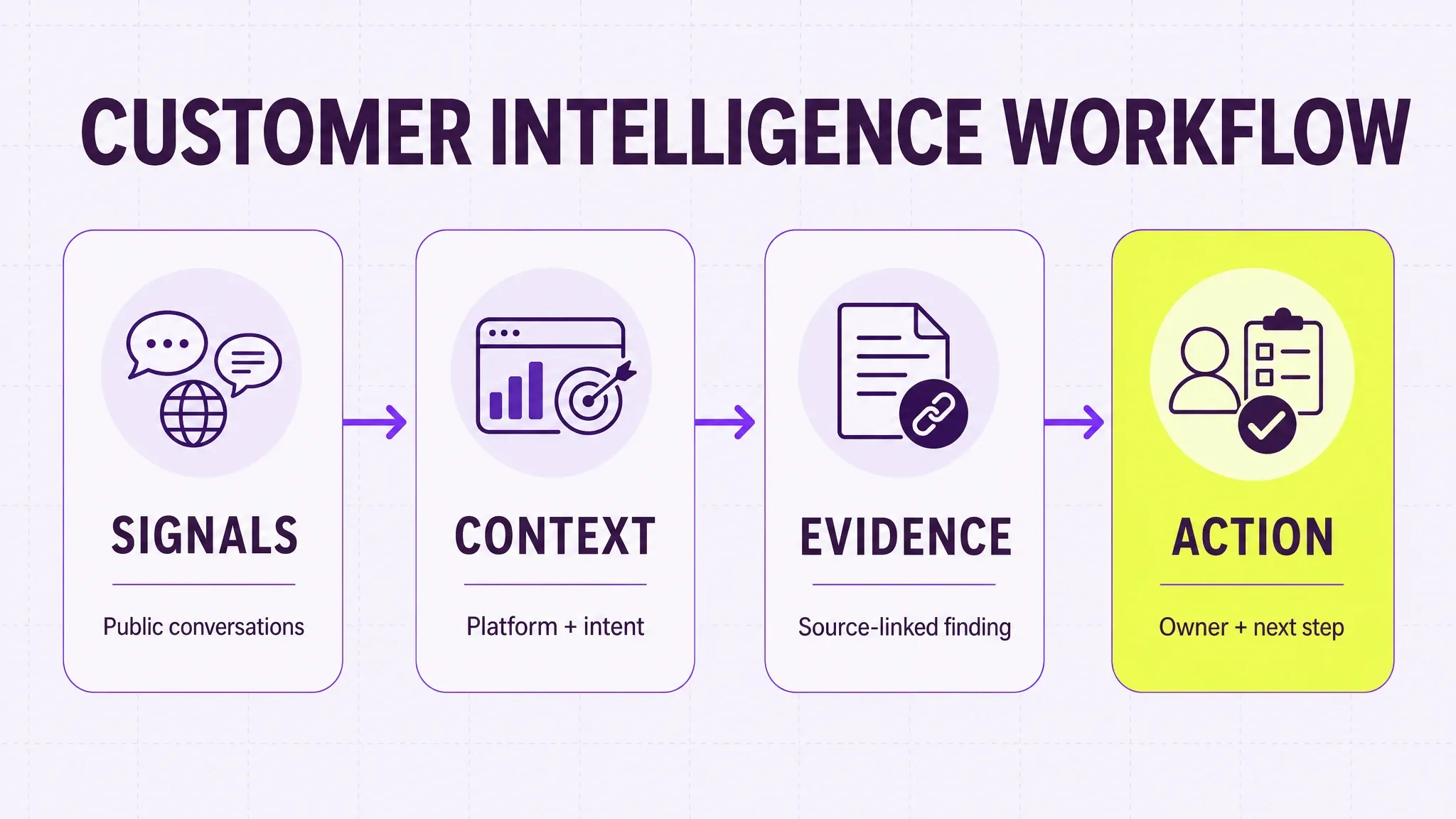
A customer intelligence platform turns customer signals into evidence a team can use. It should show what changed, explain the needs or objections behind the change, and let people inspect the source before making a decision. The right platform depends less on the size of its dashboard than on the questions your team needs to answer and the data it can legitimately access.
The short answer
A customer intelligence platform collects or connects customer-related data, finds meaningful patterns, and presents them in a form that marketing, product, research, support, or leadership teams can act on. Some platforms are built around first-party profiles and transactions. Others analyze feedback, calls, reviews, communities, or public conversations. A few combine several layers.
That distinction matters. A platform cannot explain the whole customer if it only sees one part of the journey. Buyers should ask what data is included, what is excluded, how a finding can be verified, and which decisions the output is designed to support.
What is a customer intelligence platform?
Customer intelligence is the process of gathering customer signals and turning them into a clearer view of needs, behavior, preferences, friction, and change. A customer intelligence platform provides the infrastructure and analysis layer for that work.
The category is broad. In some organizations, “customer insights platform” means software that unifies behavioral and transactional data. In others, it means a system that analyzes unstructured feedback. For a global consumer brand, public posts, comments, communities, and reviews can add another view: what people say before buying, while comparing products, and after living with them.
The useful question is not whether one definition is universally correct. It is whether the platform's input data and analysis match the decision in front of the team.
You will also see the term consumer intelligence platform. The two overlap heavily. Customer intelligence usually starts from people who already buy from you; consumer intelligence usually looks wider, at the market and at people who have not bought from you yet, which is where public posts, reviews and communities come in.
What makes the output intelligence rather than another dashboard?
More data does not automatically produce a better decision. A customer intelligence platform becomes useful when it preserves the path from a topline change to the evidence behind it.
Three qualities matter:
- Context: The platform separates channels, markets, products, customer stages, and time windows instead of flattening them into one average.
- Traceability: A finding can be checked against the underlying record, post, comment, review, or other source available to the system.
- Actionability: The output is specific enough to assign to a team, test against another dataset, or revisit at a defined date.
Without context, a spike is only a spike. Without traceability, a summary is difficult to trust. Without an owner and review window, an insight often ends as a slide.
What is a customer intelligence dashboard?
A customer intelligence dashboard is the working view where teams move from a change in customer or market signals to the evidence and next action. It should do more than combine charts. A useful dashboard explains what changed, which segment or source drove it, and where a reviewer can inspect the underlying record.
The exact views depend on the platform's data boundary. A first-party platform may emphasize profiles, retention, and transactions. A feedback or public-signal platform may emphasize recurring themes, objections, platforms, and source examples. In either case, the dashboard should make its scope visible.
Dashboard view | Question it should answer | Evidence to keep nearby |
|---|---|---|
Customer or market overview | What changed during the selected period? | Metric definition, baseline, date range, and filters |
Theme and friction view | Which needs, objections, or problems recur? | Customer language, frequency, and source examples |
Segment or platform comparison | Where is the pattern strongest or different? | Segment rules, platform mix, and sample boundary |
Source-evidence view | Can a reviewer verify the finding? | Original records, posts, comments, reviews, or calls |
Action view | Who owns the next step and when will it be reviewed? | Owner, decision, due date, and review status |
The dashboard is not the intelligence by itself. Its job is to shorten the path between a signal, the context behind it, and a decision the team can revisit.
Customer intelligence platform vs CRM, CDP, feedback analytics and social listening
These systems can complement one another, but they are not interchangeable.
System | Typical input | Primary job | What it may not explain alone |
|---|---|---|---|
CRM | Contacts, accounts, sales and service interactions | Manage customer relationships and workflows | Broader market conversation or unrecorded buyer hesitation |
CDP | First-party behavior, profiles, transactions, identifiers | Unify profiles and activate customer data | Why a recurring objection exists in customer language |
Feedback analytics | Surveys, tickets, calls, reviews | Organize owned feedback and recurring themes | What non-customers and category audiences say publicly |
Social listening | Public posts, comments, communities, reviews | Track market conversation, themes, sentiment, and competitors | First-party identity, transaction, or account history |
Customer intelligence platform | One or more signal layers plus analysis | Connect evidence to customer and market decisions | Anything outside its declared data boundary |
A customer intelligence tool should be explicit about where it sits in this stack. DataScaler, for example, focuses on public consumer signals. It does not claim to replace a CRM, support system, survey program, or first-party data warehouse.
A customer feedback analytics tool sits closer to a survey and ticket system: it finds themes in feedback you already collect, such as NPS comments, support tickets and reviews. A customer intelligence platform is broader and is judged on whether its findings change a decision. If your main question is what existing customers tell your support team, feedback analytics may be enough. If you also need to know what competitors' customers and undecided buyers say in public, you need a source of public data as well.
A live example: moving from Bambu Lab metrics to a decision
The current Bambu Lab sample shows why the evidence path matters.
Source and boundary
- Source: DataScaler live Bambu Lab sample, accessed August 20, 2026
- Window shown: Last 7 days
- Included: Public conversations represented in the live DataScaler report
- Product coverage: DataScaler currently describes coverage across 10 public platforms
- Excluded: Private CRM records, support tickets, sales data, and first-party customer profiles
- Interpretation boundary: A changing live proof case, not a category benchmark
The sample reported 21.7K related conversations, 147.8M potential reach, and 74% positive conversation. Those figures establish scale and direction. They do not yet tell a product or brand team what deserves attention.
The next layer is a source-linked finding: entry-level products were earning strong reviews, while one reliability complaint needed attention. That statement is more useful because it names both the growth signal and the issue to verify. The report also exposes the supporting reference, so a team can inspect the conversation before deciding whether the complaint is isolated, repeated, severe, or already resolved.
Dashboard layer | What the sample shows | Decision question |
|---|---|---|
Scale | 21.7K related conversations | Is the change large enough to investigate? |
Exposure | 147.8M potential reach | How widely could the conversation travel? |
Direction | 74% positive conversation | Is the overall response broadly favorable? |
Finding | Strong entry-level reviews plus a reliability concern | Which products and issues are driving the topline? |
Evidence | Source reference attached to the finding | Does the original context support the summary? |
Action | Verify, assign, and set a review date | Who should do what next? |

The example is intentionally narrow. It shows how a public-signal customer intelligence workflow can shorten the distance from market activity to a verifiable question. It does not prove purchase behavior or replace first-party product and support data.
Seven questions to ask before choosing customer intelligence software
1. Which decision will the platform support?
Start with a recurring business question, not a feature list. Examples include launch feedback, buyer hesitation, reputation risk, competitor movement, content planning, product friction, or support priorities.
If the team cannot name the decision, it will struggle to define useful inputs and success measures.
2. Which data sources are included?
Ask for a plain-language inventory. Does the platform use CRM records, transactions, surveys, calls, tickets, product reviews, social platforms, communities, or third-party sources? Which markets, languages, and historical windows are available?
Also record exclusions. A clear boundary is more trustworthy than a claim to see the “complete customer.”
3. Can people open the evidence behind a finding?
Aggregated charts help teams scan. Important findings still need a path back to the underlying source. That path also helps people catch classification mistakes, sarcasm, duplicated content, temporary amplification, and missing context.
4. Does the platform preserve useful differences?
Channels play different roles. A short-form video may generate discovery while a forum thread carries long-term ownership questions. A single blended sentiment score can hide that difference.
Look for platform, market, product, audience, and time-based cuts that match the business question.
5. Can it separate repeated patterns from one large source?
One viral post and 50 independent complaints are different signals. Useful customer intelligence tools show frequency, concentration, source count, and the items responsible for a change.
6. Can a finding move into a workflow?
The platform should make it possible to record an owner, next step, decision status, and review date, whether inside the product or through an existing team process. Intelligence that cannot leave the dashboard rarely changes the work.
7. Are the update cadence and claims realistic?
The correct refresh rate depends on the use case. Crisis monitoring may need higher frequency; brand and product research may work on weekly or monthly review windows. Verify what is actually refreshed and avoid assuming that every metric is real time.

How to run a 30-day customer intelligence platform pilot
A pilot should test one decision from source to action. It does not need to reproduce the vendor's full demo.
Pilot step | Practical test | Evidence to keep |
|---|---|---|
Define | Choose one brand, product, market, and question | Written scope and exclusions |
Baseline | Record the current signal level and known issues | Metrics, themes, source examples |
Verify | Open the evidence behind three to five findings | Source links and reviewer notes |
Route | Assign at least one finding to an owner | Owner, next step, due date |
Recheck | Review the same scope after the agreed interval | What persisted, changed, or disappeared |
Measure | Compare the process with the previous workflow | Research time, verification time, decisions supported |
Useful pilot measures include time spent collecting material, time from finding to source, the percentage of findings that survive review, and the number of findings that receive an owner. These are process measures, not promises of revenue attribution.
Where DataScaler fits
DataScaler is a public-signal customer and consumer intelligence platform for global brands. It analyzes public posts, comments, communities, and reviews across 10 platforms, organizes recurring themes and competitor movement, and keeps a source trail attached to each finding.
The Brand Monitoring solution covers the detection layer: changes in mentions, sentiment, risks, and competitors. The Social Listening solution adds customer language, objections, and platform context. The social listening metrics guide explains how to measure that layer without stopping at mentions and sentiment. The Voice of Customer analysis guide shows how to verify and route recurring feedback, while the brand intelligence comparison clarifies the adjacent monitoring categories.
This public-market view can complement first-party systems. It should not be described as a replacement for CRM, support, sales, survey, or transaction data.
FAQ
What is the best customer intelligence platform?
There is no universal best platform. The right choice matches the decision, data boundary, markets, evidence requirements, and team workflow. Test shortlisted platforms on the same known question and compare whether their findings can be verified and assigned.
What should a customer intelligence dashboard include?
It should include a clear scope and time range, a view of meaningful changes, recurring customer themes, segment or platform context, access to source evidence, and an action view with owners and review dates. The mix of metrics should match the platform's actual data coverage.
What is the difference between a customer intelligence platform and a customer insights platform?
Vendors often use the terms interchangeably. In practice, both aim to turn customer-related data into decisions. The important distinction is the input: first-party profiles, behavioral data, feedback, public conversations, or a combination.
Does a customer intelligence platform replace a CRM or CDP?
Usually not. A CRM manages customer relationships and interactions. A CDP unifies first-party profiles and behavior. A customer intelligence platform analyzes one or more signal layers to explain patterns and support decisions.
How should a team measure the ROI of customer intelligence software?
Start with observable workflow changes: research hours saved, time from signal to evidence, recurring issues found earlier, findings verified, and decisions assigned. Connect these measures to commercial outcomes only when the organization has a defensible attribution method.
What does DataScaler add to a customer intelligence stack?
DataScaler adds public-market evidence: cross-platform conversation, recurring customer language, competitor signals, and links back to the original sources. It complements first-party customer systems with what buyers and category audiences say publicly.
Start with one brand and one question
Use the DataScaler Playground to inspect a live example or enter your own brand. Begin with a narrow question, open the source evidence, and decide whether the finding belongs in the next team meeting.