
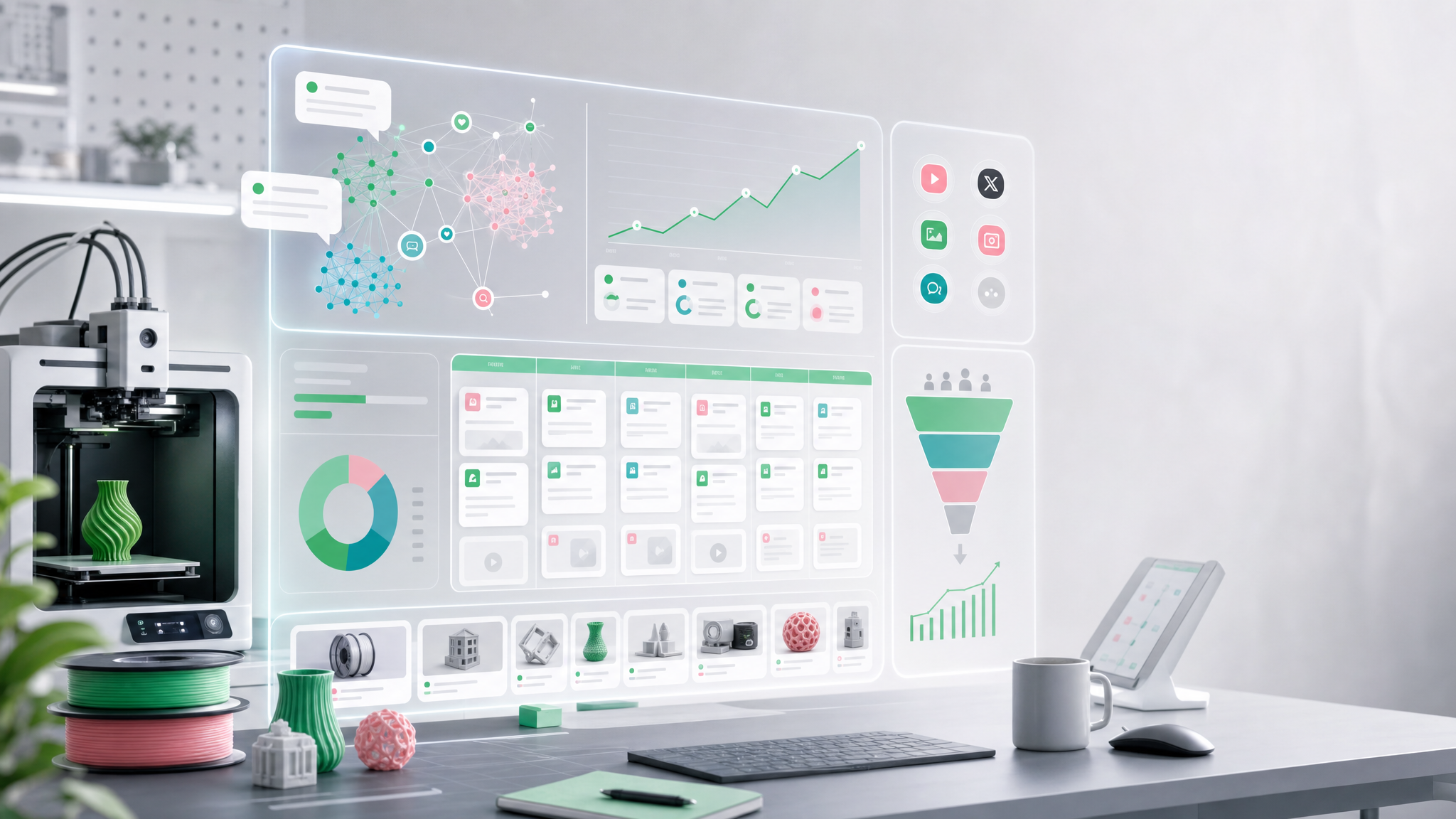
Content teams already have enough production tools. Keyword platforms provide search volume. AI can draft an article. YouTube Analytics records watch time, and an affiliate dashboard records clicks and commissions. The difficult part is choosing the next question worth answering.
That choice matters in categories such as 3D printers, consumer electronics, creator hardware, outdoor equipment, and AI tools. Buyers often watch an unboxing, compare alternatives, read Reddit, scan YouTube comments, and search for terms such as “problem,” “worth it,” “vs,” and “after 30 days.” They want to know whether the product fits their situation and what ownership will involve.
DataScaler MCP brings public discussion, competitor signals, platform differences, and source-level posts into an MCP-compatible AI client. A creator, affiliate manager, or SEO team can query those signals in natural language before deciding whether to make a review, comparison, FAQ, buying guide, or creator brief.
Traffic, keywords, and buyer questions are different signals
Views show that a piece of content attracted attention. They do not prove that viewers are ready to buy. Keywords show what people search for, but may not explain the reason for the search. Product content presents the item; its comments often record what remains unresolved.
Common mistake | Surface signal | Better research question |
|---|---|---|
Treating traffic as buyer intent | High views, rankings, or engagement | Are buyers still concerned about battery life, heat, support, or price? |
Treating a keyword as a full strategy | “Best 3D printer” has search volume | What is a beginner choosing between, and what will ownership cost? |
Ignoring the comment layer | The main review is positive | Do comments repeat competitor comparisons, failures, or purchase hesitation? |
Prosumer buyers research deeply before purchase and often describe their experience afterward. Content for this audience needs to explain fit, tradeoffs, risk, and continuing cost.
What DataScaler MCP does in a content workflow
A manual research session may involve opening YouTube, Reddit, X, TikTok, forums, and review platforms, then searching brand and competitor names and copying recurring comments into a document. With MCP connected, an AI client can query the public signals already organized in a DataScaler knowledge space.
A team can ask:
- What are customers praising and criticizing now?
- Which competitors appear repeatedly?
- Which platform builds trust, and which exposes risk?
- Which recurring questions deserve an FAQ or a dedicated review?
- Which source posts should an editor inspect?

The results can feed topic planning, YouTube scripts, SEO outlines, FAQs, product comparisons, creator briefs, affiliate pages, content refreshes, and post-publish reviews.
Five signals a content team can use
Signal | Question answered | Possible content output |
|---|---|---|
Market snapshot | Is there active discussion and a credible content opportunity? | Trend framing and topic priority |
Competitor comparison | Which brands and use cases are buyers comparing? | Comparison pages, reviews, and buying guides |
Voice of Customer | How do buyers describe needs, praise, and concern? | Headlines, scripts, FAQs, and creator briefs |
Platform analysis | Where do discovery, validation, and risk discussion happen? | Channel-specific content and distribution |
Source-level posts | Can an editor verify the conclusion? | Evidence-backed briefs and content updates |
The snapshot helps a team decide whether to invest. Competitor signals reveal the buyer's shortlist. VOC preserves customer wording. Platform analysis separates discovery channels from decision channels. Source posts provide the context needed to check an AI summary.

Three practical uses
3D printers: move from rankings to a specific choice
“Best 3D printers for 2026” competes with many similar pages. A content team can first query recent public discussion around Bambu Lab, Creality, Anycubic, and ELEGOO, then group buying concerns, competitor comparisons, negative feedback, and comment questions.
The useful questions tend to be more specific. Is Bambu Lab worth more because it is easier to use? Is Creality a better fit for someone who likes tinkering? Do beginners underestimate failed prints, filament, replacement parts, and support? Which machine makes sense for a small Etsy business?
Those questions can become a beginner's guide, a use-case comparison between Bambu Lab and Creality, an ownership-cost explainer, or a long-term reliability review. The content helps a buyer decide which printer fits instead of repeating a generic winner.
Consumer tech: write comment questions into the script
Reviews of phones, earbuds, chargers, and cameras often follow the same order: unboxing, design, specifications, pros and cons, then a recommendation. Comments usually contain the practical questions that format misses, such as whether charging remains stable, whether the device runs hot, whether an existing owner should upgrade, and whether reported failures are common.
For an Anker Prime Charger, a team could query the previous 30 days of customer voice and use the repeated questions as the script. Start with who the product suits. Then cover speed, heat, stability, alternatives at the same price, and upgrade value. End by saying who can skip it.
This approach also maps more naturally to searches such as “is it worth it,” “problems,” “vs,” “alternative,” and long-term review.
Creator briefs: begin with buyer questions
A brief made only of features, benefits, use cases, and a discount code often turns a review into an ad. A more useful brief tells the creator which competitors buyers mention, what beginners fear, which claims need hands-on testing, and which misunderstandings need an explanation.
A 3D printer brief could ask the creator to show setup and a complete print, explain how a failure is diagnosed, compare the product with an alternative buyers already mention, and state who should or should not buy. Brand information remains in the brief, but the buyer's decision determines its structure.
A 30-day content loop
A team can run a content iteration in five steps:
- Choose a category, brand, or product.
- Query praise, complaints, competitors, and platform signals.
- Place each question in discovery, comparison, validation, or near-purchase intent.
- Turn the signal into explainer, comparison, validation, or conversion-support content.
- Monitor new comments after publication and use them in the next cycle.
One analysis might plan five blog topics, three YouTube review angles, ten short-form scripts, one buying guide, one competitor comparison, one FAQ set, one affiliate objection section, and one creator brief. These counts illustrate a workflow; they are not fixed output requirements.

Evidence boundary
This is a workflow guide, not a demand forecast or conversion-attribution study. DataScaler MCP works with public discussion, including public posts and visible comments from YouTube, Reddit, X, TikTok, review platforms, and forums. Coverage depends on the knowledge-space configuration.
Public conversation can reveal recurring objections and comparison language. It does not represent every buyer and cannot prove that a topic will generate sales. Treat the AI output as a research starting point. Before publication, inspect the source posts and combine those findings with search data, platform performance, and observed conversion.
FAQ
What can creators, affiliates, and SEO teams do with DataScaler MCP?
They can bring public customer discussion and competitor signals into an AI workflow, then use those signals to plan reviews, comparisons, FAQs, buying guides, and creator briefs that address buyer decisions.
How is it different from keyword tools or traditional social listening?
Keyword tools mainly show what people search for. Traditional social listening often emphasizes volume, sentiment, and terms. DataScaler MCP also keeps platform differences, competitor context, customer wording, and source posts available for natural-language analysis in an AI client.
Why should an editor still inspect the source posts?
A summary compresses context. The source post helps an editor distinguish an owner's experience from a pre-purchase question or an isolated complaint, and it preserves the language the customer actually used.