
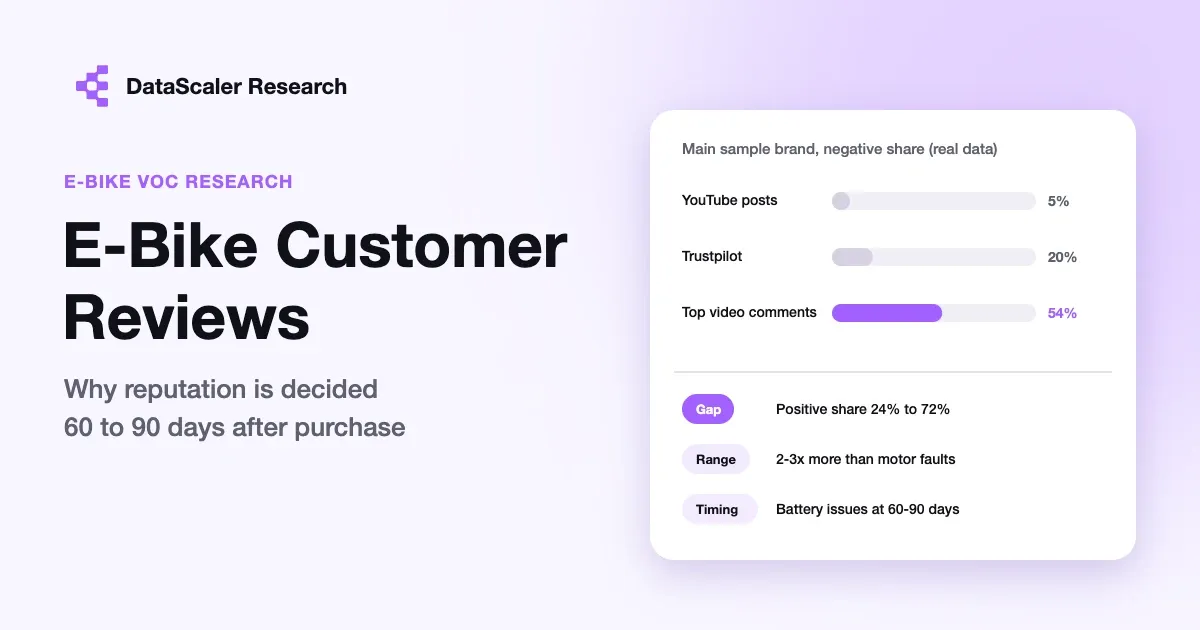
Quick answer: In public reviews and comments about four leading e-bike brands, the deciding moment for reputation was not delivery. It was the second and third month of ownership. Delivery barely came up: one mention of a bike arriving damaged, none of missing parts. Battery and electrical problems took 6 of the top 10 negative keywords for the brand with the steadiest reputation, and they clustered 60 to 90 days after purchase. Range claims were the other big gap: real-world range was mentioned two to three times as often as motor faults.
That timing matters right now. Bikes sold on Black Friday (November 27, 2026) will reach the 60 to 90 day window between late January and late February 2027. What current owners are saying is a preview of the service load brands should plan for.
What we analyzed
DataScaler collected 30 days of public posts, reviews and comments about four leading e-bike brands, covering entry-level, mid-range and upper-mid price bands, with a focus on Europe and North America.
Sample measure | Value |
|---|---|
Window | September 20 to October 20, 2026 |
Platforms | YouTube, TikTok, Trustpilot, Facebook, Instagram, Pinterest, Threads, X |
Posts | 583 |
Brand mentions | 1,617 |
User comments | 2,500+ |
Reach | 1.32 million+ |
Languages | English, German, French, Italian, Spanish |
Average positive share | 48% across the four brands |
Brand names and models are not shown. Five patterns stood out.
1. Reach and reputation are moving apart
Positive share ranged from 72% for the best-rated brand to 24% for the lowest, a 48-point gap. In a category where buyers compare a handful of well-known brands, that is a wide spread, and it suggests service quality has not yet evened out.
More visibility did not mean a better reputation:
Brand profile | Share of posts or reach | Positive share | What it shows |
|---|---|---|---|
Reach leader | 64% of total reach | 38% | High visibility brings more people into the comments, including critics |
Content-heavy brand | Close to half of all posts, 18% of reach | 72% | Steady content can build a positive reputation with less reach |
Steady-reputation brand | Under a third of a rival's post count, similar reach, 17% of category reach | 8% negative | Strong reputation, but seen by fewer people |
High reach sends more potential buyers into the comment section, and every unanswered question there gets amplified with it. Content distribution and reputation need to be measured separately: one decides how many people see the brand, the other decides what they conclude.
2. Specs still win buyers, and range claims create the biggest gap
The main sample was the steady-reputation brand, a mid-range maker of folding and cargo commuter bikes with an 8% negative share. Eight of its top 10 positive keywords were specs: a payload rating around 200 kg, a mid-drive motor in the 100 N·m class, a claimed range above 130 km, dual removable batteries and 4.0-inch fat tires. E-bike brands still compete mainly on the spec sheet.
The one service keyword in that top 10 was "customer service," and it tied for first place. When specs look alike, good service is one of the few things buyers notice and name.
Range showed up on both the positive and the negative list. A German-speaking owner wrote: "Da steht doch immer was von 100km Reichweite" ("It always says 100 km of range"), while getting about 15 km in practice. A French-speaking owner said a model sold with 130 km of range never went past 20 km in eco mode.
These are individual cases, but grouped by topic, range complaints appeared two to three times as often as motor faults. Range depends on load, assist level, temperature and terrain. Stating the test conditions next to the claimed range, and giving a realistic commuting range on the product page and in the FAQ, is the cheapest way to close that gap.
3. E-bike battery problems peak 60 to 90 days after purchase
For bulky products shipped across borders, brands usually worry most about damage in transit and difficult assembly. In this sample, those worries looked mostly solved: one mention of a bike arriving damaged, none of missing parts, and assembly comments that were mostly positive ("came with all the tools").
The problems came later. Six of the main sample brand's top 10 negative keywords pointed to batteries and electrical systems: torque sensor replacement, chargers that stopped working, battery durability, battery range and battery replacement. Lining up the ownership periods people mentioned gives a clear lifecycle:
Ownership stage | What owners talked about |
|---|---|
0 to 30 days (delivery) | Shipping time, the occasional damaged part, missing accessories |
30 to 60 days (settling in) | Good riding experience; payload and range drive satisfaction |
60 to 90 days (electrical problems) | Charging systems, torque sensors, slow replacements |
1 year and later (battery wear) | Battery life and the cost of a new battery |
One Trustpilot review from mid-October followed this curve almost exactly. The owner bought the bike 12 weeks earlier: it arrived three weeks after ordering, missing accessories arrived three weeks after that, the charging system failed three weeks into riding, and the problem had lasted three weeks when the review was posted. The fault appeared on day 63 and the review went up on day 84.
Spare parts came up less often, but the impact was high. One owner asked: "How do I buy a new charger for my [...]? My bike is currently useless as it has no charge." A satisfied reviewer even advised others to keep their own spare parts and follow repair videos. Being able to buy core parts quickly is a service buyers value over the long run.
4. What buyers worry about depends on price and market
Service concerns differed by price band and by region. European buyers paid close attention to who they were really buying from: whether the company on the invoice matched the return address, whether replacement parts shipped from the right country, and who would pay to send a bike back across a border. As one reviewer put it, a bike cannot be returned by post at any sensible cost.
Three of the four brands faced comments about where the bikes were made. Brands with a local service network saw other buyers step in to answer, pointing out that what matters more is the company that designs, tests and supports the bike. Access to service shaped opinion more than country of origin did.
5. The comment section has become a public test of after-sales service
For the main sample brand, YouTube carried 69% of posts and 98% of reach, and only 5% of posts were negative. The comments under the most-watched videos told a different story: 54% negative under a 45,000-view cargo riding video, and 50% under an 11,000-view model review.

On Trustpilot, the same brand's negative share was 20%, about four times its YouTube post level. One review title summed up the problem: "Quick replies, but disappointing warranty service." The praise that stood out went to a different brand that fixed a problem in a single afternoon. Buyers judge service by whether the problem gets solved, not by how fast the first reply comes.
We have seen the same gap between calm posts and critical comments in other categories. Our brand monitoring guide shows it for a 3D printer brand with 3% negative posts and 60% negative comments under its top video.
How e-bike brands can prepare before Black Friday
- Check in at 45 to 60 days. Contact new owners about battery and charging before the 60 to 90 day window, reply to after-sales tickets within 48 hours and aim to close them within a week.
- Keep core parts in stock and on sale. Make chargers and batteries available to buy on their own, and hold stock in each main market.
- Align range claims with real use. Publish test conditions next to the claimed range, and add a realistic commuting range to product pages and the FAQ.
- Answer in public. Reply to every one- and two-star review, and respond to after-sales questions in the comments under high-reach videos.
- Set clear service terms by region. In Europe, state the local return address, the selling company and the legal warranty. In English-speaking markets, state replacement times and send progress updates without being asked.
Get the order right: first make clear who is responsible, then speed up how problems are closed, then work on response time.
Track e-bike reviews before the next service wave
A dashboard that shows 8% negative sentiment can hide a comment section that is 54% negative, and a review site that is four times harsher than YouTube. The useful view keeps reviews, comments and posts together, breaks them out by platform and ownership stage, and links each theme to the original posts. Our voice of the customer guide explains how to turn that into a monthly routine, and the earlier e-bike consumer sentiment analysis covers the wider category.
See what owners say about your brand and your competitors. Run a free brand report to see reviews, comments and the posts behind each theme, or book a demo.
FAQ
What do e-bike customer reviews complain about most?
For the brand with the steadiest reputation in this sample, battery and electrical issues: 6 of its top 10 negative keywords were about chargers, torque sensors, battery life, battery range and battery replacement. Gaps between claimed and real-world range were also common.
When do e-bike problems usually appear?
Most often 60 to 90 days after purchase, when charging systems and torque sensors start to fail. Delivery problems were rare in this sample, and battery wear becomes the main topic after the first year.
Why do e-bike owners get less range than advertised?
Range depends on rider and cargo weight, assist level, temperature and terrain. Advertised figures are usually measured in ideal conditions, so owners commuting with load or in cold weather see much less. Brands can reduce complaints by stating test conditions.
Does more brand reach mean better e-bike reviews?
No. In this sample, the brand with 64% of reach had a 38% positive share, while a brand with 18% of reach had 72%. Reach and reputation need to be tracked separately.
How should e-bike brands prepare for Black Friday?
Plan for the service load as well as the sales. Bikes sold on Black Friday reach the 60 to 90 day window in late January to late February. Check in with owners before then, keep chargers and batteries in stock, and make service terms clear in each market.
Methodology and sources
DataScaler analyzed public posts, reviews and comments about four leading e-bike brands from September 20 to October 20, 2026, on YouTube, Trustpilot, Facebook, Instagram, Pinterest, Threads, X and TikTok, in five languages. The brands cover entry-level, mid-range and upper-mid price bands, with a focus on Europe and North America. The sample includes 583 posts, 1,617 brand mentions, more than 2,500 comments and more than 1.32 million reach. The average positive share is a simple average of the four brands. Sentiment and topics are model-classified. Range test results, spare parts feedback and the ownership timeline are based on individual cases and show direction only; ownership stages come from periods owners mentioned themselves. Brand names and models are removed, and quoted reviews are reproduced as written.
Planning for the January service wave? Generate a free brand report to see what owners say about your brand, or book a demo.