
Most advice on negative brand sentiment starts with the response: reply faster, post more positive content, ask happy customers for reviews. Those steps help, but they skip the part that decides whether anything changes. Negative sentiment is a symptom. Until you know what is causing it, you are treating the score, not the problem.
Quick answer
To fix negative brand sentiment, first break it down by theme and platform, then check that the signal is real by reading the posts behind it. Match the fix to the cause: a product or service problem needs an operational fix, an expectation gap needs clearer claims, and missing or wrong information needs better sources. Respond where the conversation actually happens. Because AI search tools build their answers from public web sources, the same work is what changes how ChatGPT, Google's AI answers and Perplexity describe your brand.
Start by finding out what kind of negative sentiment you have
A negative share of 20% can mean very different things. In DataScaler's 30-day data on NVIDIA during the November 2026 RTX 50 price rise, 23% of posts were negative, against 9% for AMD on almost the same volume of mentions. That gap was not about product quality. Price terms made up half of the hits among NVIDIA's top 30 negative keywords.
Most negative conversation falls into one of five types. Each one needs a different fix and a different owner.
Type | What it looks like | Example from public data | Fix | Usual owner |
|---|---|---|---|---|
Real product or service problem | Specific failures that repeat across independent posts | E-bike owners reporting chargers and torque sensors failing 60 to 90 days after purchase | Fix the product or process, then say what changed | Product, operations, support |
Expectation gap | The product works, but not as advertised | E-bike owners getting 15 to 20 km of range from bikes sold with 100 km or more | Make claims specific and state test conditions | Product marketing |
Explanation gap | Customers invent their own reason for a change | Gamers linking NVIDIA's price rise to an "AI focus" | Give the reason yourself, early and plainly | Communications, product marketing |
Wrong or outdated information | Claims that were never true or are no longer true | Old pricing, discontinued problems, misread specs | Correct the sources people and AI tools read | Marketing, PR |
Noise | Sarcasm, jokes, unrelated meanings, signals you cannot trace | 36 negative "reliability" mentions in a Bambu Lab sample that matched no public posts | Exclude it, and say so in the report | Insights |
The last row matters more than it looks. In DataScaler's 90-day Bambu Lab research, a negative "reliability" theme appeared 36 times in the dashboard, but no public posts could be matched to it. The team excluded it from the recommendations instead of launching a reliability campaign against a problem it could not verify.
Step 1: Measure by theme and platform, not one score
A single sentiment score hides where the problem lives. Split negative share by platform, and list the top negative keywords for each.

Two patterns show up again and again in public data:
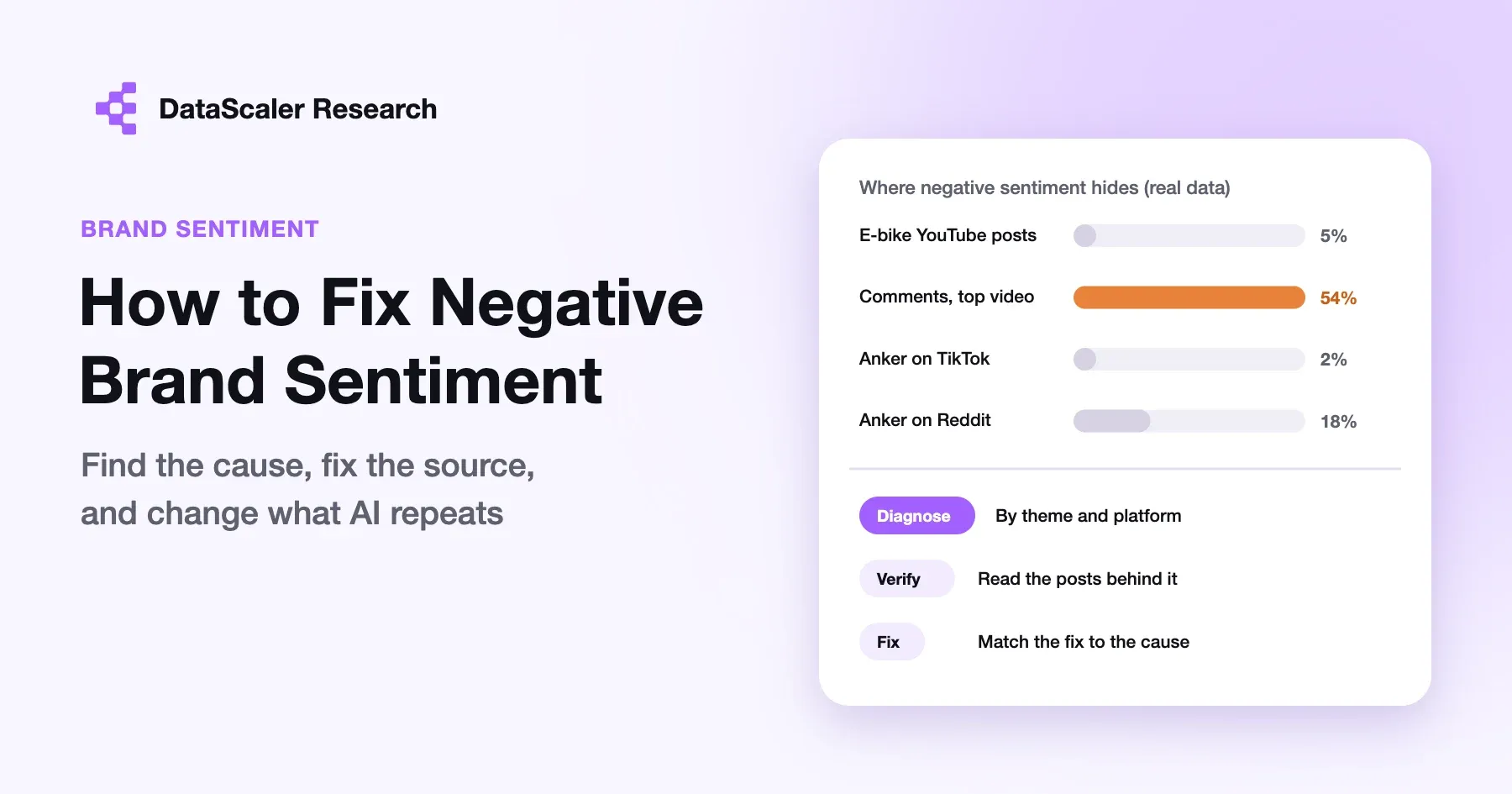
- Criticism concentrates on discussion platforms. In DataScaler's one-year Anker data, about half of all brand mentions came from Reddit, and Reddit had the highest negative share of any platform at 18%, against 2% on TikTok. During NVIDIA's price rise, Instagram stayed calm while Reddit, X, YouTube and TikTok carried the criticism.
- The comments can disagree with the posts. For one e-bike brand, only 5% of YouTube posts were negative, but the comments under its most-watched videos ran 50% to 54% negative. A post-level score would have called that brand's YouTube presence healthy.
Also look at the ratio inside a theme, not only the count. For NVIDIA, "price" appeared about 2.5 times more often in negative posts than in positive ones. For AMD, the same word was close to even. The topic was identical; the verdict was not.
Step 2: Check that the signal is real
Before anyone writes a response or changes a product page, open the posts behind each negative theme. Read at least a handful from different authors and platforms, and record:
- what the person actually said, in their own words;
- whether they own the product, are considering it or are reacting to news;
- whether the post is about you or about a different product with a similar name;
- whether several independent people say the same thing, or one post is being shared widely.
This step catches sarcasm, misclassified posts and one viral complaint that looks like a trend. It also gives you the exact wording customers use, which you will need in step 3.
Step 3: Match the fix to the cause
Product and service problems cannot be fixed with content. If e-bike chargers fail at 60 to 90 days, the fix is in sourcing, quality control or the replacement process. Once it is fixed, tell people: reply in the threads where the problem was reported, update the help article and note the change on the product page.
Expectation gaps are often the cheapest to close. If real-world range is the main complaint, state the test conditions next to the claimed range, and give a realistic commuting range in the FAQ. Fewer buyers will feel misled, even though the product has not changed.
Explanation gaps need a reason from you. When a price goes up, people look for one. If the brand does not give it, customers supply their own, and it is rarely flattering. Track which explanation is spreading and answer that one directly on your pricing page, in your FAQ and in support replies.
Wrong or outdated information needs the source corrected, not just a reply. Find the page, review or listing that carries the claim and fix it where you can: your own old pages, directory and comparison listings, partner sites. Where you cannot edit the source, publish a clear, dated page that states the current facts.
Step 4: Respond where the conversation happens
If half of the conversation about your brand is on Reddit, a post on your own Instagram will not reach it. Reply in the threads and comment sections where the criticism is, as a named person from the brand, and keep it specific: what happened, what you are doing, where to get help.
A few rules keep this from backfiring:
- Do not argue with an accurate complaint. Acknowledge it and say what changes.
- Do not post as a customer. Communities spot it fast, and it becomes a new complaint.
- Do not delete criticism you can reply to. Deleted threads tend to come back as screenshots.
How to fix negative brand sentiment in AI answers
More buyers now ask ChatGPT, Google's AI answers or Perplexity about a brand before they visit its website. Those tools search the web and build an answer from the sources they find. In a public study of more than 21,000 citations across 602 prompts, ChatGPT cited about 7 sources per answer on average, Google's AI answers about 12 and Perplexity about 16, and the strongest predictor of being cited was how directly a page answered the question (GEOLab).
That means an AI answer usually repeats what the public web already says about you. You cannot delete a negative statement from a model, but you can change what it finds.
- Ask the questions buyers ask. Run the same prompts in each tool, such as "Is [brand] worth it?", "[brand] vs [competitor]" and "problems with [brand]". Run each one several times, because answers vary, and save the full text.
- Trace each negative claim to its sources. Note which pages, threads and reviews the answer cites or paraphrases. Compare them with the negative themes from step 1. They usually overlap.
- Sort each claim into the five types above. An AI answer that repeats an accurate complaint needs the same operational fix as the original complaint. One that repeats outdated information needs the source corrected.
- Publish pages that answer the question directly. If buyers ask about reliability, a page with specific failure rates, warranty terms and replacement times gives AI tools something better to cite than a two-year-old forum thread. Pages with numbers, definitions, comparisons and steps are cited more often than vague ones.
- Earn mentions from third parties. AI tools lean heavily on independent sources such as news coverage, reviews, comparison sites and community discussions. Accurate listings on directories and honest participation in communities matter more than more copy on your own site.
- Recheck every month. Track whether the negative claim still appears, how it is worded and which sources are cited. Softer wording often comes before the claim disappears.
Expect this to take weeks or months, not days, and expect some negative statements to stay if they are accurate. The aim is an answer that is current and fair, not one that is flattering.
How to tell if the fix is working
Metric | What to watch | Why |
|---|---|---|
Negative share by platform | Change on the platform where the problem was concentrated | A blended score can improve while the real problem stays |
Top negative keywords | Whether the specific terms drop out of the top 10 | Shows the cause, not just the mood |
Positive-to-negative ratio within a theme | For example, "price" in positive vs. negative posts | Shows whether the verdict on that topic is shifting |
New complaints vs. old ones | Whether new posts repeat the issue | Old threads keep ranking; new posts show the current state |
AI answer wording | Whether the claim appears, softens or disappears | Shows what buyers see before they reach your site |
Set a baseline before you act, and compare 30 and 60 days later. If negative share drops but the same keywords stay at the top, the problem is still there, only quieter.
Frequently asked questions
Can you remove negative sentiment from ChatGPT?
Not directly. AI search tools build answers from public sources, so you change the answer by changing those sources: fixing the underlying problem, correcting outdated pages and listings, and publishing clear, dated pages that answer the question. Accurate negative statements will usually stay until the facts change.
Is some negative brand sentiment normal?
Yes. Every brand with real customers has some. What matters is whether it is concentrated in one theme or platform, whether it is growing, and how it compares with competitors over the same period. NVIDIA's 23% negative share stood out because AMD was at 9% on the same volume.
How long does it take to improve brand sentiment?
For a specific complaint, expect changes in new posts within one or two months after a real fix, while old threads keep appearing in search for much longer. Track new posts separately from the total to see progress sooner.
What causes negative brand sentiment?
The most common causes are product or service failures, claims that set the wrong expectation, price changes without a clear reason, and outdated or wrong information. Reading the posts behind each negative theme is the fastest way to tell them apart.
See what is driving your negative sentiment
DataScaler collects public posts, comments and reviews across 10 platforms, groups negative conversation by theme and platform, and links every finding to the original posts, so you can see the cause before you choose the fix. Run a free brand report to see your top negative keywords and where they come from.
For more on reading sentiment, see our guide to brand sentiment analysis. For a worked example of how a price change plays out, read how customers reacted to NVIDIA's price increase.
Sources
- DataScaler, NVIDIA price increase: how customers reacted on social media, November 2026.
- DataScaler, E-bike customer reviews, October 2026.
- DataScaler, Reddit social listening, Anker one-year data.
- DataScaler, Bambu Lab 90-day social listening research.
- GEOLab, AI search citation experiments: 602 prompts and 21,143 citations across ChatGPT, Google AI Overviews and Perplexity.