
Plenty of smaller consumer brands launch with very little research. Surveys and focus groups cost money and time, and by the time the product is ready the team is busy with photography, listings and inventory.
Yet the buyers you want to reach are already talking. They are comparing the products you will compete with in YouTube reviews, asking "is this worth it?" on Reddit, and leaving three-star reviews that explain exactly what disappointed them. That conversation will not tell you how many units you will sell. It will tell you what people want from the category, what makes them hesitate, and which promises they are already testing.
This guide shows how to turn it into decisions before launch, using examples from DataScaler's 2026 research. In short, validating a product idea this way takes five steps: decide which launch decisions the research must inform; study the category and the products you will be compared with; separate what buyers want from what makes them hesitate; check whether your headline claim is already doubted; and turn each repeated hesitation into something you ship.
Decide what the research has to answer
Research without a decision attached turns into a slide nobody uses. Before you collect anything, write down the launch decisions you still have to make. For most consumer products, they fall into five groups:
Launch decision | What public conversation can tell you |
|---|---|
Positioning | Which benefits buyers mention in their own words, and which they ignore |
Price framing | Whether price comes up alone or next to doubts about value, quality or ongoing cost |
Objections | What makes interested people hesitate, and on which platform |
Proof | Which claims buyers already distrust and what evidence they ask for |
Launch content | Which questions keep coming up that nobody answers well |
If a finding does not change one of these decisions, it is background, not research.
Study the products you will be compared with
You cannot listen to a product that does not exist yet. You can listen to everything around it:
- The category, such as "AI voice recorder" or "ergonomic chair."
- The three to five products a buyer would put next to yours. Use the names buyers use, not your internal list.
- The problem itself, in plain words: "back pain from desk chair," "too many meeting notes."
- The substitutes people already rely on. For AI recorders, that turned out to be the phone.
Collect from the places where people evaluate, not only where they discover. In our e-bike and AI recorder research, YouTube and Reddit carried the detailed comparisons and doubts, Instagram and Pinterest carried inspiration, and Trustpilot showed what owners said after buying. Our guide to YouTube social listening covers how to read the comments where much of that evaluation happens.
Separate what people want from what stops them
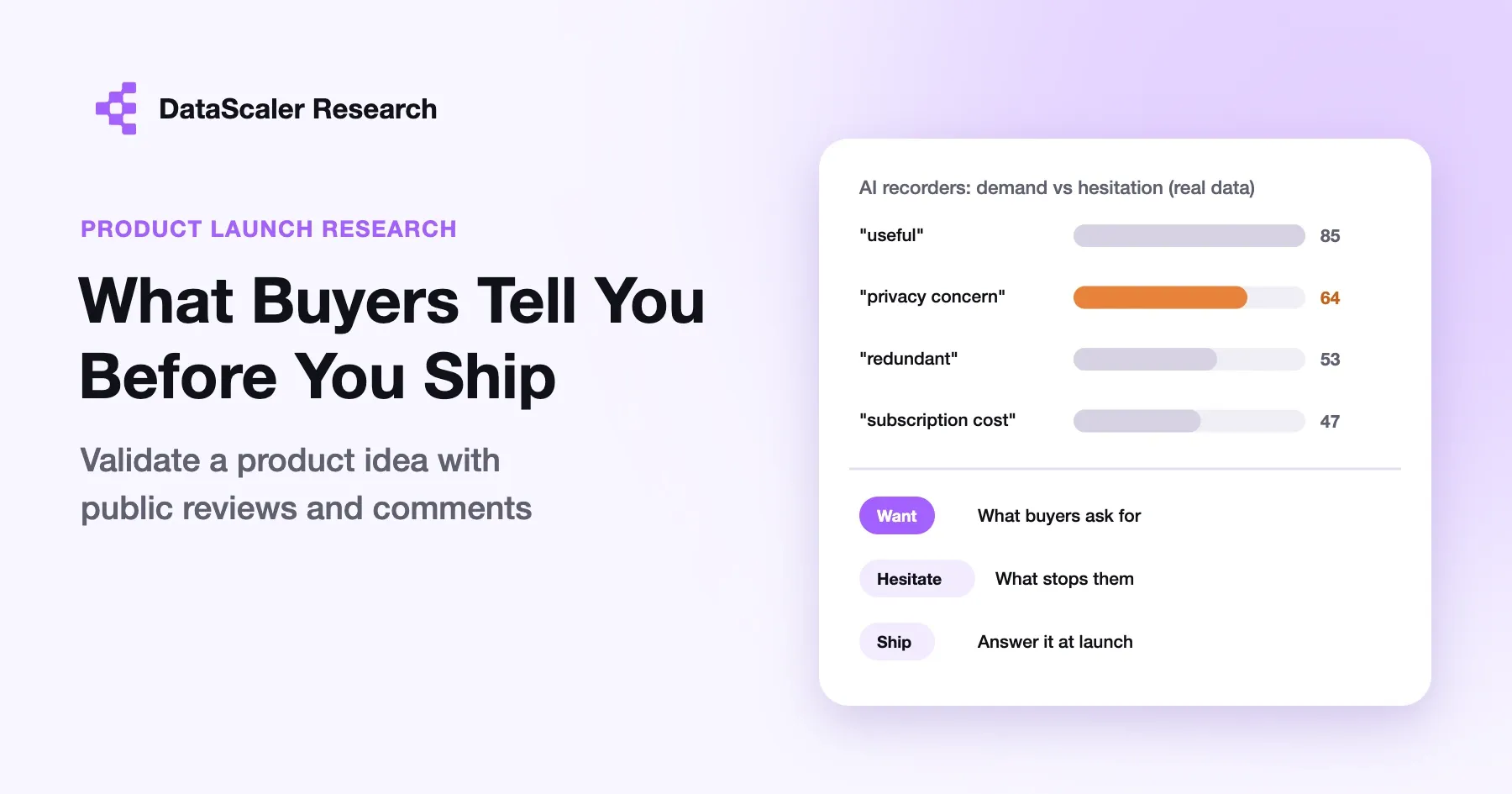
The most useful single step is to split the conversation into two lists: demand language and hesitation language. Our study of Plaud AI recorders shows why.
Demand terms | Count | Hesitation terms | Count |
|---|---|---|---|
useful | 85 | privacy concern | 64 |
helpful | 67 | redundant | 53 |
game changer | 54 | subscription cost | 47 |
note taking | 48 | phone alternative | 39 |
Plaud-related public conversation, June 10 to July 10, 2026.
Demand was clearly there. But the hesitation list tells a launch team three specific things: buyers want to know where recordings go, they need a reason the phone in their pocket is not enough, and they want the subscription justified after paying for the hardware. Those are three pieces of launch content, and none of them is "make more people aware of the product."
Hesitation also had a home. Of the 57 posts that raised privacy concerns, 22 were on YouTube and 21 on TikTok, so that is where the answers needed to appear.
Expect your headline promise to be tested
Whatever you lead with is what reviewers will check first. In a 30-day sample from the ergonomic chair category, "lumbar support" was the strongest demand term, appearing 146 times. The same term appeared 47 times in negative contexts, next to "uncomfortable" (54) and "back pain" (45).
For a new chair, that is a warning and a brief. If you lead with lumbar support, the launch needs fit guidance, adjustment instructions, honest notes on who the chair does not suit, and long-term proof, because buyers in this category are already testing that exact claim.
Before launch, take your planned headline claim and search for it in competitors' reviews. Our Amazon review analysis method shows a repeatable way to do that. If it already appears in complaints, prepare the proof before you publish the claim.
Do not confuse attention with confidence
A noisy category can look like an easy launch. Our 30-day e-bike sample had about 322.8 million in estimated reach, yet 51% of the conversation was neutral: comparisons, observations and questions without a verdict. Price came up 260 times ("expensive" 143 and "price" 117), and safety concern 125 times.
Interest was not the problem. Buyers were stuck on price and safety. A new e-bike brand entering that category with another lifestyle video would add to the attention without resolving either doubt. The research points to a different launch plan: a clear price-versus-value story, and concrete safety evidence such as certifications, tests and rider guidance.
Turn findings into launch assets
Research is finished when it has changed something you will ship. A simple way to close the loop is to map each repeated hesitation to an asset and an owner before launch day:
Repeated hesitation | Launch asset | Owner |
|---|---|---|
"Is my data safe?" | A plain-language privacy section on the product page and FAQ | Product marketing |
"My phone already does this" | A comparison page showing the full workflow, not just the hardware | Content |
"Is the subscription worth it?" | A clear list of what the ongoing fee pays for | Pricing and lifecycle |
"Will it really help my back?" | Fit and adjustment guide, plus who it is not for | Product and support |
"Is it safe?" | Certifications, test results and rider guidance | Product and compliance |
Brief creators with the same list. If reviewers are going to raise these questions anyway, it is better that your launch materials answer them first.
What this research cannot do
Public conversation shows what people say, not what they will buy. It will not give you a sales forecast or market share. Platforms are uneven, sentiment is model-classified and misses sarcasm, and a loud minority can dominate a thread.
Treat the findings as hypotheses, then test the important ones cheaply: a waitlist or pre-order page that leads with one positioning, a handful of customer interviews, or a small run before the full order. Research tells you which questions to test. Tests tell you the answer.
Common questions
How do you validate a product idea before launch?
Start with the conversation that already exists. Study the category, the products you will be compared with and the problem you solve. Separate what buyers want from what makes them hesitate, check whether your headline claim is already doubted, and then test the most important assumptions with a waitlist, pre-orders or interviews.
How much research is enough before a launch?
There is no fixed number, but a 30-day window across the three to five closest competitors usually surfaces the main demand themes and objections. A practical stopping point is when new sources keep repeating the hesitations you have already logged.
What if nobody is talking about my category yet?
Study the problem and the substitutes instead. People who have never heard of an AI recorder still talk about losing meeting notes and recording calls on their phone.
Can social listening predict whether a product will sell?
No. It shows repeated demand and hesitation in public conversation. Use it to decide what to say, what to prove and what to test, and use sales tests to measure demand.
Start with the product you will compete with
You can run this research on a competitor before your own product exists. Generate a free DataScaler report on the brand you expect buyers to compare you with, and see its themes, hesitations and the source posts behind them.
Methodology and sources
- Plaud: DataScaler's AI recorder analysis, public posts and visible comments from June 10 to July 10, 2026. 64 is a mention count; 57 is the number of related source posts.
- Ergonomic chairs: DataScaler's ergonomic chair review analysis, one anonymized 30-day public conversation sample.
- E-bikes: DataScaler's e-bike sentiment analysis, 2,439 posts and 41,351 mentions across seven platforms over 30 days.
- Sentiment and themes are model-classified. Counts are mentions or posts, not unique people or sales.