
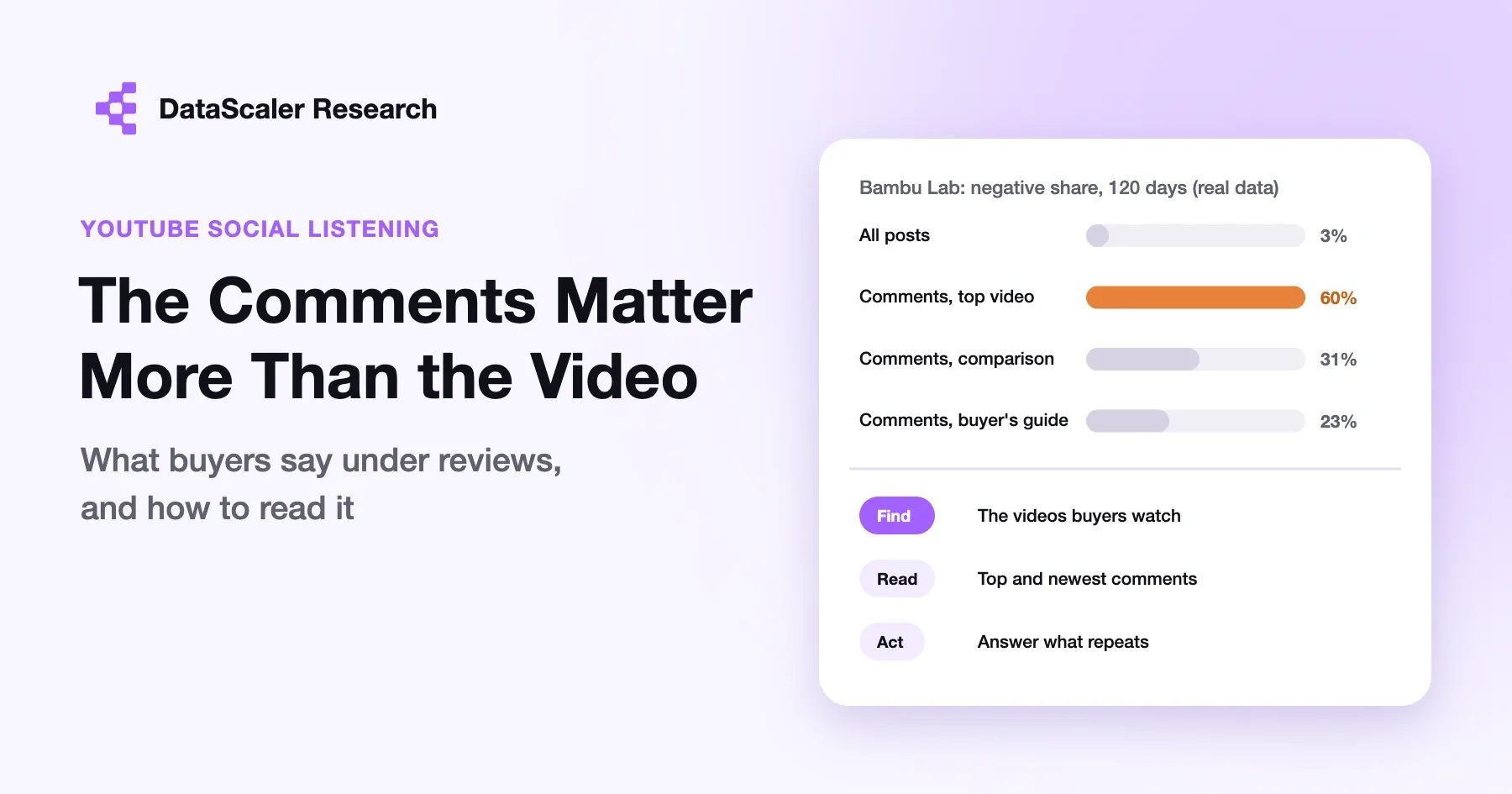
In 120 days of public conversation about Bambu Lab, the 3D printer brand, only 3% of posts were negative. A brand team looking at that number would move on.
Under the most-viewed YouTube video in the same dataset, a 494,000-view video titled "The Satisfying Downfall of Bambu Lab," 60% of the 146 comments we analyzed were negative. Viewers were not complaining about print quality. They were arguing about whether the company was becoming "anti-consumer" and a "closed garden." That debate will never show up in a star rating, and it sits on a video that hesitant buyers can still find months later.
That gap between the video and the comments is the reason YouTube needs its own approach to social listening.

What makes YouTube different
Most social platforms are about what is new. YouTube is about what is findable. A review published a year ago can still rank in YouTube and Google search for "best budget 3D printer" and still collect comments today. Three things follow from that:
- Videos keep working long after launch. A single comparison video can shape purchases for months, so one high-view video can matter more than a hundred posts.
- The audience is usually researching. People watch reviews, setup guides and head-to-head comparisons when they are close to a decision.
- The comments are where viewers push back. The creator gives a verdict. The comment section is where owners add their experience, rivals' fans argue and undecided buyers ask the question the video skipped.
Shorts are the exception. They behave more like TikTok: fast discovery, short reactions and less evaluation. If Shorts drive most of your views, our guide to TikTok social listening is the closer fit, and Reddit social listening covers the other place buyers go for detailed comparisons.
What our data shows about YouTube
Across three DataScaler studies from 2026, YouTube kept carrying the weight of the conversation. In the two studies with a full sentiment split, more than half of YouTube mentions were neutral rather than positive or negative.
Study | How much YouTube carried | YouTube sentiment | What stood out |
|---|---|---|---|
Bambu Lab, 90 days | 17,511 of 18,357 mentions (95.4%) | 35% positive, 57% neutral, 8% negative | The brand's overall sentiment was mostly a YouTube score |
E-bikes, 30 days | 19.9K of 41,351 mentions, the largest platform | 29% positive, 56% neutral, 15% negative | Comparisons and questions outweighed verdicts |
Plaud AI recorders, 30 days | 22 of the 57 posts raising privacy concerns, more than any other platform | 27% positive, 15% negative (neutral not reported) | Reviews discussed benefits and limits in the same video |
A high neutral share on YouTube is not a sign of weak interest. In technical categories, neutral mentions are often setup questions, specifications and comparisons: the evaluation stage of a purchase. That is exactly the conversation a product or marketing team should be reading.
What to track on YouTube
Mention counts and average sentiment are a weak fit for YouTube. These measures tell you more:
Measure | Why it matters |
|---|---|
Views on videos that mention you, and on competitors' | Shows which videos buyers actually see, so you know where to read first |
Negative share of comments on your top videos | Catches the debate a post-level score hides, as in the Bambu Lab example |
Comparison videos that include you | Each one is a sales objection with a timestamp; note who wins and why |
Questions that repeat in comments | Gaps your product page, FAQ or manual should answer |
Terms that appear in both praise and complaints | In the Bambu Lab sample, "reliability" appeared 81 times in positive themes and 36 times in negative ones; the comments tell you which version applies |
New videos above a view threshold | A fast way to catch reviews and comparisons while you can still respond |
How to do it for free
You can start without any software. It takes about an hour a week for one brand and two competitors.
- Search YouTube for your brand, each product name and "brand vs competitor." Add terms buyers use, such as "review," "worth it," "problems" and "after 6 months."
- Make a shortlist of the 10 to 20 most-viewed videos that mention you or a direct competitor, and re-check it monthly.
- Read the top comments and the newest comments on each one. Top comments show what most viewers agree with; newest comments show what is changing.
- Tag each useful comment with one label: product issue, setup question, price, comparison, trust, or praise you could reuse.
- Keep a simple sheet with the video, views, date checked, your tags and a short quote. After a month, the repeated tags are your findings.
If someone on your team can write a small script, the YouTube Data API can pull the comment threads for a given video. A request for up to 100 comment threads costs 1 unit from a default quota of 10,000 units a day, which is plenty for a shortlist of videos. Comments on videos where they are switched off cannot be retrieved.
The manual method stops working well when you track several brands, need comments from hundreds of videos, or want to compare YouTube with Reddit, TikTok and reviews in one place.
When a tool helps, and what to check
Many listening tools are built around posts and news. Before you choose one for YouTube, ask four questions:
- Does it collect comments, not just videos? In the Bambu Lab case, the risk was in the comments.
- How many comments per video does it capture? Capture is usually partial on big videos. We analyzed 146 of about 2,000 comments on the most-viewed Bambu Lab video, and good tools state that limit.
- Can you open the original comment behind every theme? Without that, you cannot check sarcasm, context or which product people meant.
- Can you see YouTube next to the other places buyers research? A theme that appears on YouTube, Reddit and Amazon Reviews is stronger than one that appears on YouTube alone.
DataScaler, which we make, reads YouTube posts and comments alongside nine other platforms, including TikTok, Reddit and Amazon Reviews (the last two as per-report add-ons), and links each theme to the source comments. For a wider comparison of options, see our guide to free social listening tools.
Common questions
What is YouTube social listening?
It is the practice of tracking and analyzing public YouTube videos and comments about your brand, competitors and category to understand how buyers evaluate them, then acting on what you find.
Is YouTube monitoring the same as YouTube social listening?
No. Monitoring tells you that a new video mentions your brand. Listening reads the video and its comments over time to find patterns, such as a repeated setup question or a comparison you keep losing.
Can you analyze YouTube comments for free?
Yes, for a small number of videos. Reading top and newest comments on your 10 to 20 most-viewed videos by hand works for one brand. The YouTube Data API is free within its daily quota if you can write a script.
Which brands should prioritize YouTube?
Brands whose buyers research before buying. In our data that includes 3D printers, e-bikes and AI recorders, and the same pattern tends to hold for other categories where reviews and comparisons drive the decision, such as consumer electronics and home appliances.
See your own YouTube conversation
Run a free DataScaler report on your brand to see how much of your conversation happens on YouTube, which themes come up in the comments, and the original comments behind each one.
Methodology and sources
- Bambu Lab: DataScaler's 90-day social listening case study (655 posts, 18,357 post and comment mentions across YouTube, Instagram and X) and the 120-day brand monitoring example (posts and comments to October 28, 2026).
- E-bikes: DataScaler's 30-day e-bike sentiment analysis, 2,439 posts and 41,351 mentions across seven platforms.
- Plaud: DataScaler's AI recorder analysis, public conversation from June 10 to July 10, 2026.
- Sentiment and themes are model-classified. Counts are mentions or posts, not unique people or sales. Comment capture is partial on high-view videos.
- Google, YouTube Data API overview and CommentThreads: list, checked November 19, 2026.