
Quick answer: TikTok social listening means tracking and analyzing what people say about your brand, products, competitors and category on TikTok, in videos and especially in the comments under them, and turning that into decisions. It works differently from listening on X or Reddit. Most TikTok conversation is neutral discovery, a single video can outweigh months of mentions, and the verdict usually sits in the comments rather than the caption. That changes what you track and which tools are worth paying for.
This guide covers what makes TikTok different, three real examples from DataScaler research, a step-by-step way to start, free options, and what to check before choosing a TikTok monitoring tool. If social listening is new to you, start with what social listening is.
What makes TikTok social listening different
Four things set TikTok apart from other platforms, and each one affects how you should read the data.
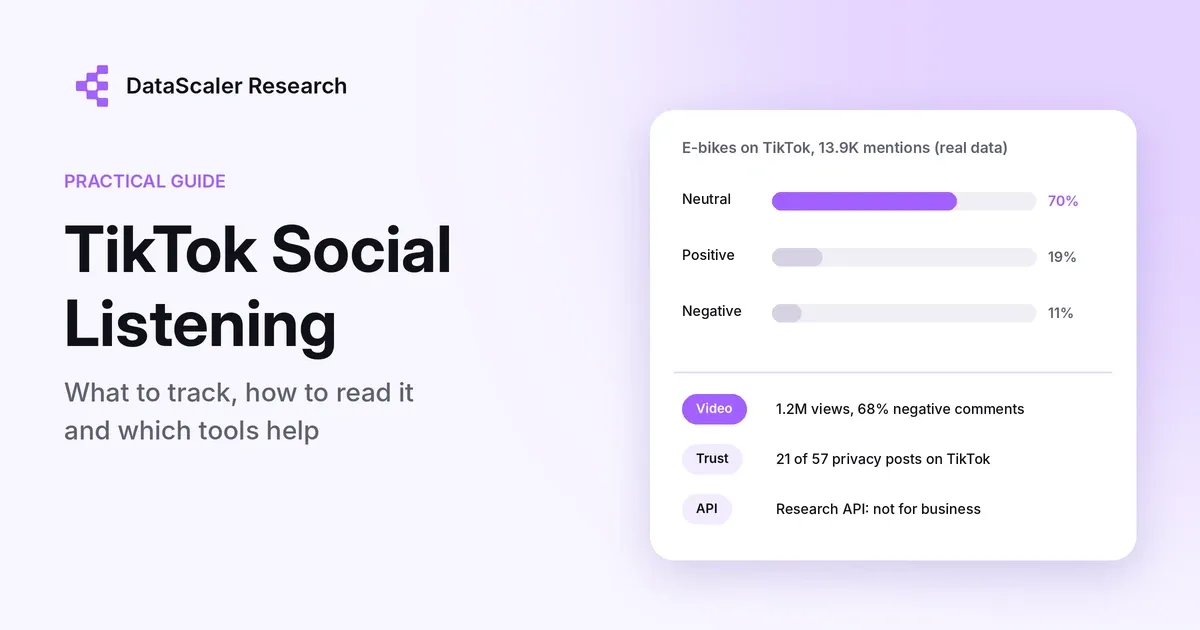
Most mentions are neutral. People on TikTok show, react and ask more than they judge. In our e-bike category research, TikTok carried 13,900 mentions in 30 days, second only to YouTube, but 70% of them were neutral, the highest share of the seven platforms we tracked. A sentiment score built on that base says little on its own.
A few videos carry most of the weight. Reach on TikTok is uneven. One video can reach more people than a brand's entire month of mentions on other platforms, so totals and averages hide what matters.
The verdict lives in the comments. The caption tells you what the creator wanted to say. The comments tell you whether viewers believe it, what they compare it with and what stops them from buying.
Data access is limited. TikTok's Research API is for approved research projects, and its FAQ states that commercial users, creators and advertisers are not eligible. New videos can also take up to 48 hours to appear in its search. Most commercial listening tools rely on their own collection methods, so coverage of videos and especially comments varies widely from tool to tool.
What TikTok listening found for three brands
These examples come from DataScaler research published in 2026. Each one shows a different way TikTok conversation can mislead if you only look at the summary.
Brand or category | What the data showed | What it means |
|---|---|---|
E-bikes (category, 30 days) | TikTok: 13,900 mentions, 70% neutral, 19% positive, 11% negative | TikTok drives discovery, not decisions; reach alone does not show purchase intent |
Anker (one year) | 528 TikTok mentions, against about 1,300 on Reddit. One video about a 140W travel charger reached about 1.2 million views; 68% of the 28 brand-relevant comments were negative | Low total volume, but one video can set the tone for a product |
Plaud AI recorders (one month) | 21 of the 57 posts raising privacy concerns came from TikTok, more than any platform except YouTube | Short videos sell the benefit fast, and the objections show up right underneath |
The Anker example is the clearest lesson. On a volume chart, TikTok looked like a minor channel next to Reddit. But the single video with the most reach had a comment section that leaned heavily negative. A team watching mention counts would have missed it. For the full reports, see the e-bike sentiment analysis, the Anker Reddit analysis and the AI recorder trust gap.
How to do TikTok social listening in six steps
- Build a keyword list the way TikTok users write. Include your brand name, product and model names, common misspellings, competitor names, and the hashtags people actually use. Spoken mentions are often not in the caption, so add the words people use on screen and in comments.
- Collect videos and their comments together. A video without its comments is half the data. For the top videos, capture as many comments and replies as you can.
- Rank by reach and engagement, not by date. Start each review with the ten videos that drew the most views and comments in the period.
- Separate the creator's claim from the audience's reaction. Tag what the video says (a test result, a comparison, a complaint) and, separately, what commenters say back. The gap between the two is often the insight.
- Tag comments by theme. Price, quality, comparison with a competitor, setup, trust or privacy, and requests ("does it work with…?"). Read the original comments before trusting any automated label.
- Turn findings into actions with owners. A recurring question becomes an FAQ or a listing update. A comparison video becomes a sales talking point. A trust objection goes to product or support.
To report the results, our guide to building a social listening report people will use shows a format that keeps the evidence attached.
TikTok metrics worth tracking
Metric | Why it matters on TikTok |
|---|---|
Views and comments on the top 10 videos | Reach is concentrated; the top videos shape perception |
Negative share in comments on high-reach videos | The verdict sits in comments, not captions |
Share of comparison mentions | Shows which competitor buyers weigh you against |
Recurring questions in comments | Direct input for FAQs, listings and content |
Creator vs brand-owned share of mentions | Shows how much of the conversation you do not control |
Neutral share | A high share means discovery, not decided opinion; read it before trusting sentiment |
Free ways to listen on TikTok
You can start without a tool:
- TikTok search: search your brand and product names, sort by recent, and read the comments on the top results. Repeat weekly with the same queries so results are comparable.
- TikTok Creative Center: a free public site from TikTok that shows Top Ads and trending hashtags. It is useful for seeing which formats and topics are moving, but it does not give you a full record of organic mentions or comments.
- Your own account analytics: shows how your own videos perform, not what others say about you.
Manual listening works for one brand checked once a week. It breaks down once you track competitors, need comment-level analysis at volume, or want to compare TikTok with Reddit, YouTube and reviews. Our list of free social listening tools covers more free options and when it is worth paying.
What to look for in a TikTok social listening tool
Many tools list TikTok as a source. Fewer handle it well. Before you choose, test these on your own brand:
Check | What good looks like |
|---|---|
Video coverage | Finds videos that mention your brand in captions, hashtags and, ideally, on-screen text |
Comment coverage | Collects comments and replies under high-reach videos, not just the video metadata |
Freshness | New videos appear within a day or two |
Cross-platform view | TikTok sits next to YouTube, Reddit and reviews, so you can see where a theme starts and spreads |
Traceability | Every theme and score links back to the videos and comments behind it |
Competitor tracking | You can compare your TikTok conversation with two or three competitors in the same view |
DataScaler covers TikTok alongside YouTube, Reddit, Instagram, Amazon Reviews and other public sources, and links every finding to the original post. For a broader comparison of tools and prices, see Brandwatch alternatives and pricing.
See what TikTok says about your brand. Run a free brand report to see TikTok next to your other platforms, with the posts behind every finding, or book a demo.
FAQ
What is TikTok social listening?
It is tracking and analyzing what people say about your brand, products, competitors and category on TikTok, in videos and comments, to understand perception and act on it.
What is the difference between TikTok monitoring and TikTok social listening?
Monitoring tracks mentions of your brand and flags those that need a response. Listening analyzes patterns across videos and comments, including competitors and category topics, to guide product, marketing and sales decisions. Our brand monitoring guide covers the monitoring side.
Can you do TikTok social listening for free?
Yes, for a small scope. Search TikTok for your brand and product names, read the comments on the top videos each week, and use TikTok Creative Center for trending hashtags and top ads. Free methods get hard to sustain once you track competitors or need comment analysis at volume.
Can businesses use the TikTok Research API for social listening?
No. TikTok's Research API is for approved research projects, and its FAQ says commercial users, creators and advertisers are not eligible. Commercial listening tools use their own data collection, so check each tool's TikTok coverage before buying.
What is the best social listening tool for TikTok?
It depends on what you need. If you mainly track TikTok creators and trends, a TikTok-focused tool may be enough. If you need TikTok comments read alongside YouTube, Reddit and reviews, choose a cross-platform tool that covers comments and links findings to the source. Test two tools on your own brand for a week before you commit.
Methodology and sources
The three examples summarize DataScaler research published in 2026, based on public posts and comments over the windows stated in each article: 30 days (e-bikes), one year (Anker) and one month (Plaud). Sentiment is model-classified; counts are mentions or posts, not unique people or sales. TikTok Research API eligibility and search delay are from TikTok for Developers: Research API FAQ. Creative Center features are from TikTok Ads Help: About Creative Center.
Want to know what TikTok viewers really think of your products? Generate a free brand report, or book a demo.