
Quick answer: A voice of the customer (VoC) template is a working file that turns scattered feedback into a short list of themes, each with evidence, a priority and an owner. A useful one has four parts: a theme log (one row per theme), an evidence log (the original comments behind each theme), a scoring rule (business impact × frequency) and an action tracker with check dates. Below you can download ours as an Excel file, with no sign-up, plus a version filled in with 30 days of real e-bike reviews and comments.
Most VoC templates online are survey forms or whiteboard canvases. They help you collect feedback or brainstorm it, but not decide what to do next. This one is built for consumer brands whose most honest feedback sits in public reviews, comments and forums, and for the weekly question every team ends up asking: which of these themes do we fix first, and who owns it?
If you are new to the idea, start with what voice of the customer is. This page is the hands-on part.
Download the free voice of the customer template
Both files open in Excel and Google Sheets. No email required.
File | What it contains | Download |
|---|---|---|
VoC template (XLSX, 5 tabs) | Start here, Theme log, Evidence log, Action tracker and Scoring guide. One example row per tab shows the expected format; the score and priority columns calculate themselves. | |
Filled-in example: e-bike brand (XLSX) | The same workbook completed with seven themes, six evidence rows and three tracked actions from DataScaler's 30-day e-bike research. |
What a voice of the customer template should include
Search for a VoC template and you will find three kinds. Each solves a different problem:
Template type | Good for | Where it falls short |
|---|---|---|
Survey template | Asking existing customers structured questions | Only reaches people who bought and chose to answer |
Whiteboard or canvas | A workshop where a team sorts sticky notes into needs | Loses the link to the original comments once the session ends |
Theme log workbook (this one) | Running VoC every month from reviews, social posts, tickets and surveys | Needs someone to keep the evidence log current |
A theme log works for consumer brands because their feedback arrives continuously and mostly unprompted: Amazon reviews, TikTok comments, Reddit threads, Trustpilot. You do not need another way to collect it. You need a place where each pattern is written down once, backed by real comments, ranked, and handed to someone.
That is why the template keeps five rules:
- One row per theme, not per comment. Twenty comments about range become one theme.
- Every theme links to evidence. At least three source comments, with links, before anyone acts.
- Customer words stay in. "It always says 100 km of range" tells a product team more than "range: negative."
- Priority is scored, not argued. Business impact × frequency, on the same scale every month.
- Every top theme has an owner and a check date. Otherwise it is a report, not a program.
What is inside the template
Tab | What goes in | Key columns |
|---|---|---|
Start here | Instructions, a legend for input cells and column definitions | — |
Theme log | One row per theme | Theme, Type, What customers say, Short quote, Sources, Mentions, Negative share, Business impact, Frequency, Score, Priority, Owner, Action, Status, Check date, Evidence IDs |
Evidence log | One row per source comment | Evidence ID, Theme ID, Source URL, Platform, Post date, Exact wording, Context, Customer stage, Confidence |
Action tracker | One row per decision taken on a theme | Theme ID, Decision, Owner, Due date, Metric to check, Baseline, Result at check |
Scoring guide | The 3 × 3 matrix used to set priority | Business impact (1–3) × Frequency (1–3) |
Yellow cells are inputs. The Score and Priority columns are formulas, and the Action tracker pulls the theme name from the Theme log by ID, so renaming a theme updates everywhere.
How to fill in the template in six steps
- Write down one decision. For example: "Why did returns rise on our best-selling model?" or "What should the product page answer before Black Friday?" A VoC cycle without a question collects everything and changes nothing.
- Pull two kinds of sources. At least one you ask for, such as a post-purchase survey or support tickets, and one you do not, such as reviews, TikTok comments or Reddit threads. The gap between them is often the finding.
- Group comments into themes. Write each theme the way a teammate would say it: "Battery and charging failures at 60–90 days," not "Battery – negative." Mark the type: complaint, praise, question, comparison or request.
- Fill the evidence log before scoring. Paste three to five source comments per theme, with the link and the customer's exact words. Read them. A theme labeled "price" can mean "great value" or "too expensive", and only the source comments tell you which.
- Score each theme. Business impact from 1 to 3, frequency from 1 to 3. The template multiplies them and labels the result.
- Assign owners and check dates. Every "Act now" theme goes to the Action tracker with a decision, an owner, a metric and a date four to six weeks out. On that date, go back to the same sources and see whether the theme shrank.
For the analysis behind step 3, including how to code comments consistently, see our voice of customer analysis method.
How to prioritize VoC themes
Volume is the easiest thing to count and the weakest guide to priority. The template scores each theme on two questions instead.
Business impact | Frequency: 1 (isolated) | 2 (recurring) | 3 (top theme) |
|---|---|---|---|
3: purchase objection, return, refund or chargeback | 3 | 6 | 9 |
2: support cost, churn or review-score risk | 2 | 4 | 6 |
1: nice to know, no direct cost | 1 | 2 | 3 |
A score of 6 to 9 means act now, 3 to 5 means monitor next cycle, and 1 to 2 means log only. The effect is that a theme mentioned twelve times but tied to returns outranks a theme mentioned a hundred times that costs nothing. Ask how close a theme sits to money before you ask how loud it is.
Keep praise in the log too. Praise rarely needs a fix, but it tells marketing what to keep saying, and a praised attribute that starts collecting complaints is an early warning.
Example: a VoC template filled in for an e-bike brand
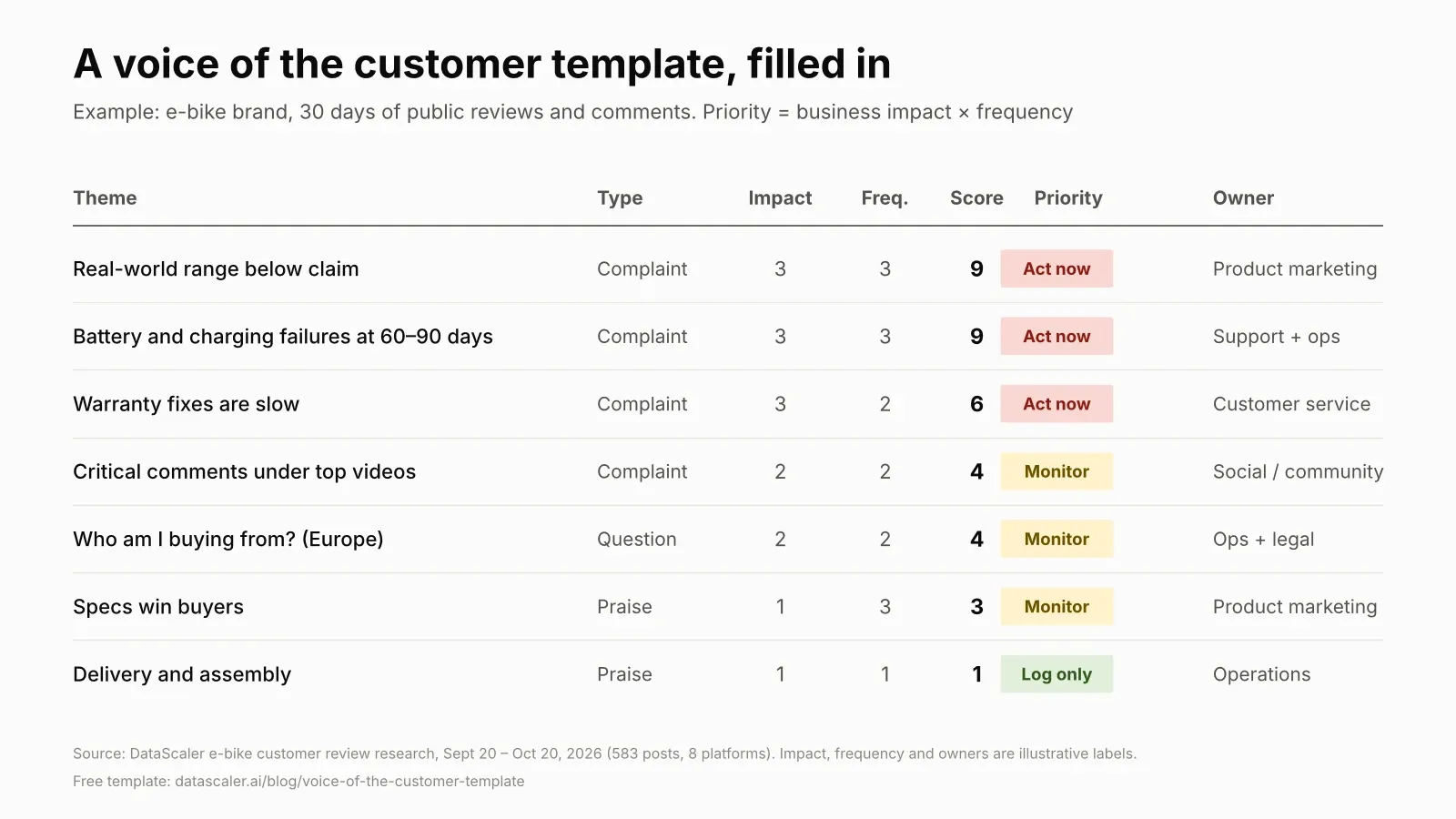
To show the template in use, we filled it in with DataScaler's e-bike customer review research: 30 days of public posts, reviews and comments about four leading e-bike brands, from September 20 to October 20, 2026. It covers 583 posts, 1,617 brand mentions and more than 2,500 comments on eight platforms. The theme log uses the brand with the steadiest reputation as the main sample.
ID | Theme | Type | What customers say | Impact | Freq. | Priority | Owner |
|---|---|---|---|---|---|---|---|
T-01 | Real-world range below claim | Complaint | About 15 km against a 100 km claim; range complaints appeared 2–3 times as often as motor faults | 3 | 3 | Act now (9) | Product marketing |
T-02 | Battery and charging failures at 60–90 days | Complaint | 6 of the top 10 negative keywords point to chargers, torque sensors and batteries | 3 | 3 | Act now (9) | Support + ops |
T-03 | Warranty fixes are slow | Complaint | Fast first replies, slow fixes; Trustpilot negative share 20%, about four times the YouTube post level | 3 | 2 | Act now (6) | Customer service |
T-04 | Critical comments under top videos | Complaint | 54% negative comments under a 45,000-view video, while posts overall were 5% negative | 2 | 2 | Monitor (4) | Social / community |
T-05 | Who am I buying from? (Europe) | Question | Does the invoice company match the return address? Who pays for a cross-border return? | 2 | 2 | Monitor (4) | Ops + legal |
T-06 | Specs win buyers | Praise | 8 of the top 10 positive keywords are specs: payload, motor, range, dual batteries | 1 | 3 | Monitor (3) | Product marketing |
T-07 | Delivery and assembly | Praise | One mention of a damaged arrival, none of missing parts | 1 | 1 | Log only (1) | Operations |
Business impact, frequency, owners and actions are our editorial labels, added to show how the template works. They are not measured fields.
Three things stand out once the research sits in this format.
The top priorities are all after-sales. Brands selling bulky products online usually worry about shipping damage and assembly. Here, delivery scored 1. The three "Act now" themes all appear after the bike arrives, two of them between day 60 and day 90. The research found one Trustpilot review that follows the curve almost exactly: the charging system failed on day 63 and the review went up on day 84.
The evidence log changes the action. "Range complaints" alone suggests a product problem. The source comments show something more fixable: owners quoting the spec sheet ("Da steht doch immer was von 100km Reichweite" — "It always says 100 km of range") against much lower real-world numbers. The action becomes publishing test conditions and a realistic commuting range, not redesigning the battery.
Small themes earn a check date, not a fix. Delivery and assembly are logged with a re-check after Black Friday deliveries. If that row moves up next cycle, you will see it, because it is already in the log.
How often to update a VoC template
Run one full cycle a month, and set each action's check date four to six weeks out so the next cycle can measure it. Between cycles, add new themes as they appear, but do not re-score everything weekly; a theme needs a few weeks of evidence before its frequency means anything.
Before a known spike, such as a product launch, a price change or the 60 to 90 days after a big sales event, add the relevant sources and set a closer check date.
When you share results with leadership, the theme log and action tracker are usually enough. If you need a full write-up, our social listening report template covers the slide format and an evidence ledger in the same style.
Common mistakes with VoC templates
- Logging comments instead of themes. A sheet with 400 rows of quotes is a data dump. Group first, then keep three to five quotes per theme as evidence.
- Scoring before reading. A label is a guess until someone has read the comments behind it. Fill the evidence log first.
- Leaving the owner column empty. If no one owns a theme after two cycles, either assign it or move it to "Parked" so the log stays honest.
- Only using surveys. Surveys reach people who already bought. Reviews and public comments show why other people did not.
FAQ
What is a voice of the customer template?
It is a structured file for collecting customer feedback into themes, attaching evidence to each theme, ranking them, and tracking who acts on them. Ours is a five-tab Excel workbook with a theme log, evidence log, action tracker and scoring guide.
What should a VoC template include?
At minimum: the theme, the customer's own words, the sources, a priority score, an owner, an action and a date to check again. Without the evidence and the owner, a template becomes a summary nobody acts on.
Can I use the template in Google Sheets?
Yes. Upload the XLSX to Google Drive and open it with Google Sheets. The score, priority and theme lookup formulas work in both.
How many themes should a VoC template have?
Aim for roughly 8 to 15 active themes per product line, so the list stays short enough to act on. If you have more than 20, some are probably the same theme worded differently; merge them.
Where should the feedback come from?
Combine at least one source you control, such as surveys or tickets, with one you do not, such as reviews, social comments and Reddit. Our guide to Amazon review analysis covers one of the richest unsolicited sources for ecommerce brands.
Methodology and sources
The filled-in example uses DataScaler's published e-bike customer review research: public posts, reviews and comments about four leading e-bike brands, September 20 to October 20, 2026, on YouTube, Trustpilot, Facebook, Instagram, Pinterest, Threads, X and TikTok, in five languages (583 posts, 1,617 brand mentions, 2,500+ comments). Sentiment and topics are model-classified; brand names and models are removed in the original research. Quotes are reproduced as published there. Business impact scores, frequency scores, owners and actions in the example are editorial labels added to demonstrate the template.
Fill in the template automatically
DataScaler collects reviews and social posts from 10 public platforms, including Amazon Reviews, Trustpilot, TikTok and Reddit, groups them into themes and links every theme to the original posts. That covers steps 2 to 4 of the template; your team keeps the scoring and the decisions.